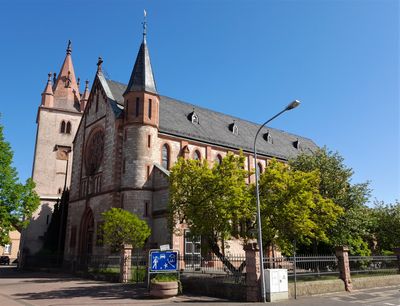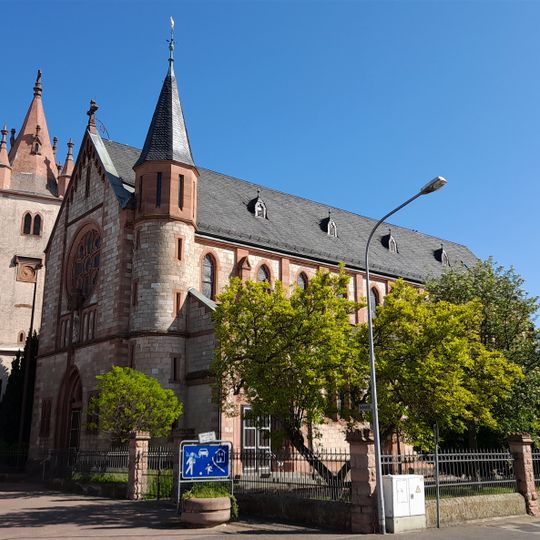
Katholische Pfarrkirche Sankt Matthias, Catholic parish church in Nieder-Roden, Rodgau, Germany
St. Matthias is the Catholic parish church of Nieder-Roden in Rodgau, built from September 1894 to its consecration on 27 September 1896 to designs by the Frankfurt architect Joseph Röder, with Jakob Frank from Dieburg as site manager. The neo-Gothic building of rough-hewn light grey and reddish stone stands at the south-east corner of the old fortified tower, which remains its bell tower. A cylindrical stair tower with a conical slate roof and weathervane marks the left front corner, beside a gabled facade with a large rose window; the nave is covered by a steep slate roof with small dormers.
The parish church was first documented on 15 August 1298, when Archbishop Gerhard II of Eppstein consecrated it; the medieval defensive tower served as its bell tower and still stands under heritage protection. The old church, enlarged in 1542, was demolished in early 1894 after Pastor Heinrich Nolda (1888–1908) pressed for a larger building. From September 1894 the Frankfurt architect Joseph Röder designed the neo-Gothic replacement, built under Jakob Frank and consecrated on 27 September 1896 by Bishop Paul Leopold Haffner.
The church is dedicated to the Apostle Matthias, whose statue with book and axe was mounted above the main portal on 24 February 1897, his feast day. For centuries Nieder-Roden's parish was the only one in the Diocese of Mainz with this patron. The romantic Schlimbach organ is kept as a rare musical-historical treasure.
The church stands in Nieder-Roden, a district of Rodgau south-east of Frankfurt, at the south-east corner of the old fortified tower, which remains free-standing beside it. The neo-Gothic building faces the street behind a metal fence; the entrance is beneath the Matthias statue above the main portal. The Schlimbach organ can be heard at services.
The old church was nicknamed the "Stall von Bethlehem" before its demolition in early 1894; the pastor had it photographed first. Three salvaged pieces were built into the new church: the tracery of a choir window, the top of a sacrament house and a stone carved with the year 1542.
The community of curious travelers
AroundUs brings together thousands of curated places, local tips, and hidden gems, enriched daily by 92,784 contributors worldwide.