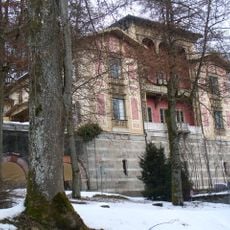
Schloss Fürstenstein, Mountain castle in Berchtesgaden, Germany.
Schloss Fürstenstein is a three-storey building with a gabled roof and a Zwerchhaus dormer, standing at Fürstensteinweg 14 on the slope of the Kälberstein above Berchtesgaden. Its facade carries classical plaster articulation, and the building was altered at the end of the 18th century and again in 1916. A chapel and a Meierhof farm building belong to the estate.
The castle was built in 1758 by Prince-Provost Michael Balthasar von Christalnigg and given to the Augustinian canons of Berchtesgaden in 1768. Following the secularization of Bavaria in 1803, it began serving different purposes that affected the town's growth and development.
The chapel of St. Marien, attached to the castle, is listed by the Bavarian State Office for Monument Protection as a Rococo building with a saddle roof and a roof turret topped by an onion dome. Its exterior frescoes and interior Rococo fittings were made by the Salzburg painter and stuccoist Benedikt Zöpf. A dining hall was added in 1800, and the chapel was deconsecrated in 1913.
The castle sits along Kalbersteig road, easily reached on foot or by car from central Berchtesgaden, making it convenient to visit while exploring the valley. Today it functions as holiday rental apartments, so interior access is limited, but the exterior architecture and surroundings are visible from public pathways.
After secularization, the castle became home to Berchtesgaden's first pharmacy, established by Michael Pirngruber in 1803 and representing a turning point in the valley's medical care. This detail connects the building's history to everyday life and shows how structures take on new roles in society.
The community of curious travelers
AroundUs brings together thousands of curated places, local tips, and hidden gems, enriched daily by 92,685 contributors worldwide.