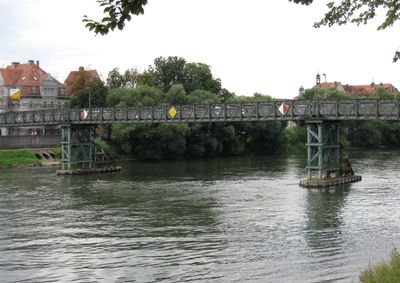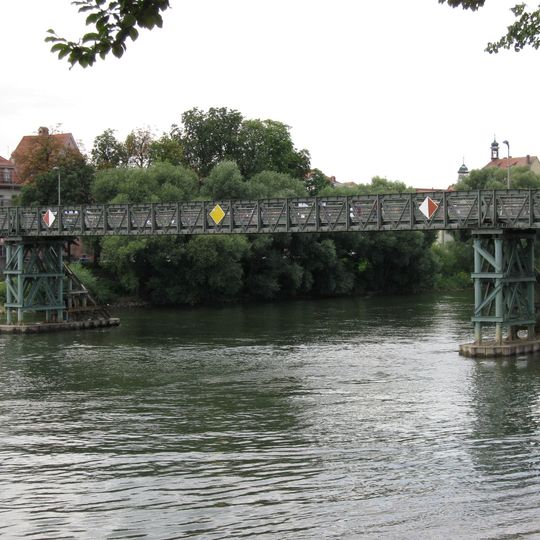
Eiserner Steg, Historic footbridge over the Danube in Regensburg, Germany.
The Eiserner Steg is a simple steel trough footbridge over the southern arm of the Danube at river kilometre 2380.07, linking Regensburg's old town with the Oberer Wöhrd. It is open to pedestrians and cyclists. It should not be confused with the Eisernen Brücke, 800 metres downstream, which carries motor traffic.
The first Eiserner Steg, a pierless steel arch 4.5 m wide and 12.5 m high, was built between 1900 and 1902 after Mayor Oskar von Stobäus proposed it in 1890; residents of the Oberer Wöhrd backed the plan despite a planned bridge toll. Wehrmacht troops blew it up on 23 April 1945. The replacement steel trough footbridge opened in 1948.
The bridge's name distinguishes it from the Eisernen Brücke 800 m downstream, which carries car traffic; between them lies the Steinerne Brücke. The crossing is open to pedestrians and cyclists, and residents of the Oberer Wöhrd once fought a years-long dispute over the bridge toll charged for its use.
The bridge is easily accessible from the old town and provides a direct crossing over the river without needing to take a longer route. The steel surface can become slippery in wet conditions, so care is needed.
The 1948 footbridge is not a converted military structure: its predecessor, a 4.5 m wide steel arch built in 1900–1902, was blown up by Wehrmacht troops on 23 April 1945. Its three debris sections lay in the Danube until a Straubing firm cleared them from October 1945, and two ferries carried people across in the meantime.
The community of curious travelers
AroundUs brings together thousands of curated places, local tips, and hidden gems, enriched daily by 92,803 contributors worldwide.