St. Xystus, Catholic church in Büchenbach, Erlangen, Germany
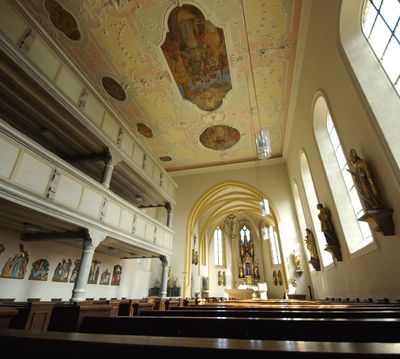
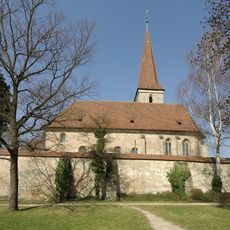
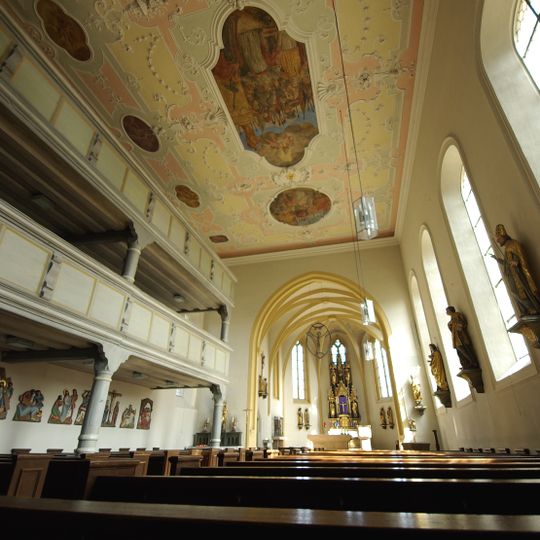
St. Xystus is a Gothic sandstone hall church at the southern edge of Büchenbach, its core dating to the 14th or 15th century. The three-bay choir with a three-octagon apse has six two-light pointed-arch tracery windows separated by seven stepped buttresses. The nave was raised in 1723 and lit by large round-arch windows on the south side.
A church at Büchenbach is mentioned in a 996 charter of Emperor Otto III, though the present Gothic sandstone building dates from the 14th or 15th century, with the choir as its oldest part. The parish was an original parish whose territory once included all of today's Erlangen parishes; the first named pastor appears in 1348. The patronage of Sixtus II is first recorded in 1476, and the nave was built around the mid-16th century and baroquised from 1706.
The parish, an original parish (Urpfarrei) whose territory once covered all of today's Erlangen parishes, is dedicated to Pope Sixtus II, whose feast day is 7 August. The church also bears the names St. Xystos and St. Sixtus, and the parish belongs to the Seelsorgebereich Erlangen Nordwest in the Archdiocese of Bamberg.
The church stands on the southern edge of Büchenbach inside a churchyard ringed by a medieval wall three to four metres high. Access is from the north, over a stone bridge with a 1746 sandstone statue of St John Nepomuk and through a round-arched gate. The former moat was filled in during the 19th century and survives only in parts.
The churchyard wall is original except for its east section, rebuilt in 1951; the moat around it was filled in during the 19th century and is only partly traceable today. A stone bridge from the north, with a 1746 sandstone statue of St John Nepomuk, leads through a round-arched gate.
The community of curious travelers
AroundUs brings together thousands of curated places, local tips, and hidden gems, enriched daily by 94,439 contributors worldwide.