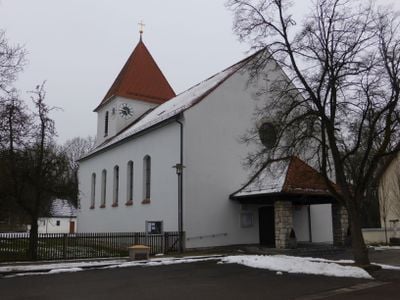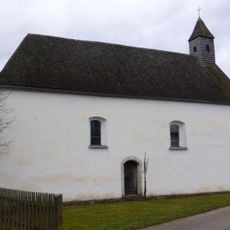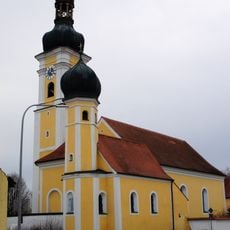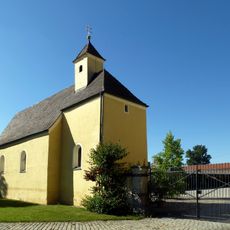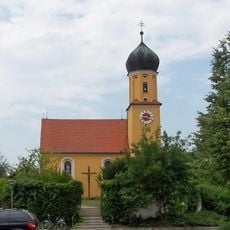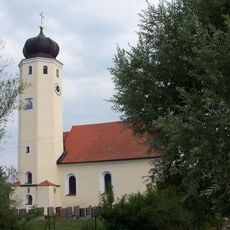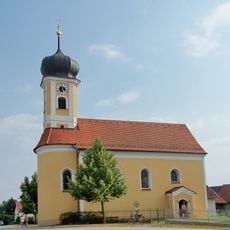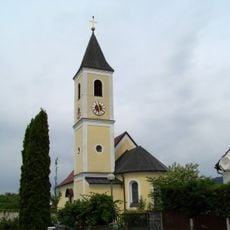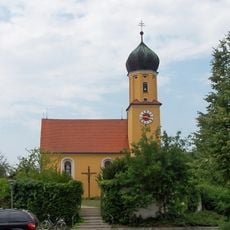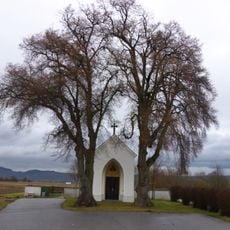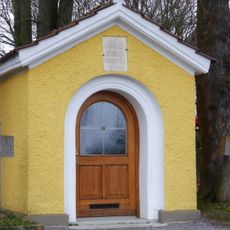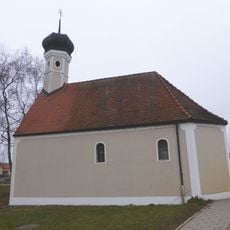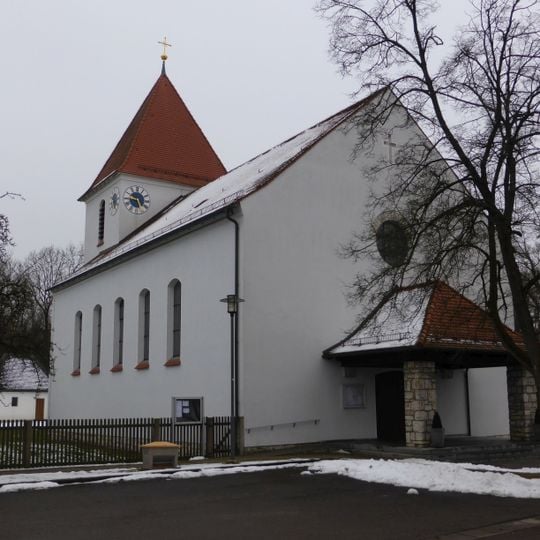
Mariä Himmelfahrt, Catholic church in Wolfskofen, Germany.
Mariä Himmelfahrt is a white-walled Catholic hall church with a red tiled roof, built 1939–1942 by Karl Schmidt Senior as a Chorturmkirche. A square tower at the left end carries a blue clock with gold Roman numerals and a steep pyramidal roof with a gold cross. Five tall arched windows with reddish sills line the long side wall; a porch on stone pillars shelters the dark entrance door at the right.
The church was built between 1939 and 1942 and remains the only Catholic house of worship financed by the Nazi government during World War II. This unusual support from that period makes it a rare religious structure from the era.
The baroque furnishings came from the former pilgrimage church of Mariä Himmelfahrt in Pappenberg, whose village was cleared for the Grafenwöhr training ground. The high altar was made by Johann Michael Doser in 1719 for 142 gulden and gilded in 1721 by Johann Thoma Wild of Auerbach. The two side altars honour St Sebastian, erected in 1640 during a plague, and St Florian, erected in 1634 after a fire in Pappenberg. The right altar holds a painted copy of the Pappenberg grace image, inscribed with its flight to Prague during the Swedish war and its re-erection in 1798.
The church stands in Wolfskofen, a district of Mintraching in the Upper Palatinate, on ground bought by the RUGES resettlement company for the relocated Pappenberg community. The entrance is through the roofed porch on the right end of the long side, sheltered by stone pillars. The village lies near the Grafenwöhr training area, so access by road is the usual approach.
A carved Madonna of the Rosary from the 1530s-1540s shows the craftsmanship of the late Gothic period through detailed drapery and fine carving. This artwork comes from a time centuries before the modern church building was constructed.
The community of curious travelers
AroundUs brings together thousands of curated places, local tips, and hidden gems, enriched daily by 94,368 contributors worldwide.