St. Gallus, Romanesque church in the Domviertel, Augsburg, Germany
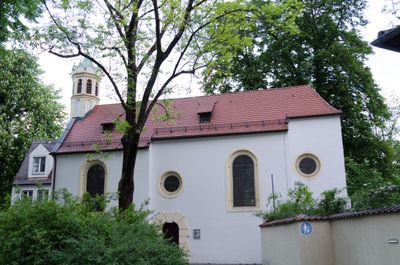
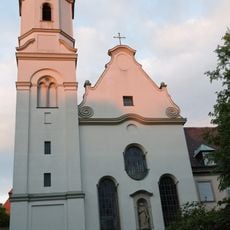
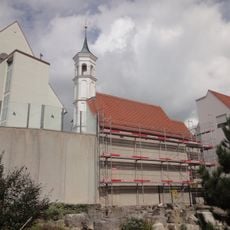
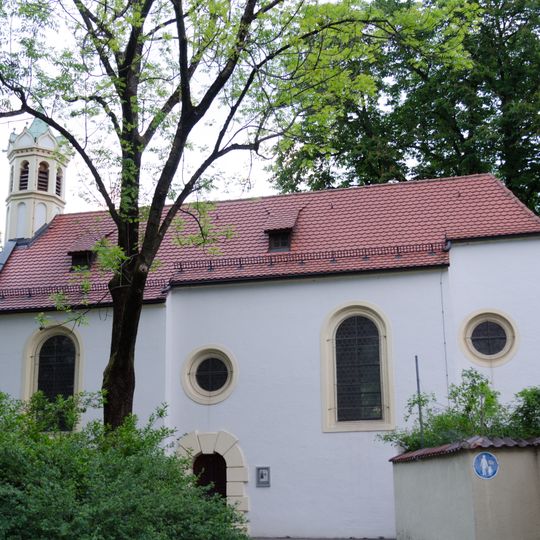
St. Gallus is a small, single-nave church on the Gallusbergle in Augsburg's Domviertel, its core dating to the 11th century. The white-walled building has a red tiled roof with a small dormer and dark cresting, and a tower on the left with a grey pointed spire above an octagonal belfry with arched openings. The main facade shows a large arched window with dark lattice, two round windows, and a stone-framed arched entryway.
The church was built around 900 on the remains of a Roman shrine and later blessed by Pope Leo IX during his visit in the 11th century. This layering of ancient and Christian history shaped the building from its inception.
The church's patron is Saint Gallus, an Irish monk; the dedication likely came only in the 11th century, when the building was reconsecrated by Pope Leo IX in 1051. Before that it probably carried the patronage of Saint Stephen, which later passed to the neighbouring church of St. Stephan. A chaplaincy endowed here is recorded from 1367.
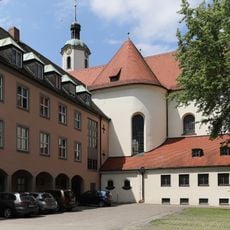
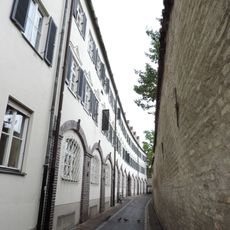
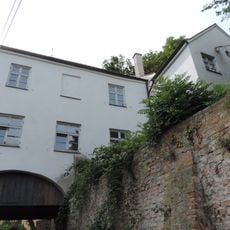
St. Gallus stands on the Gallusbergle at Gallusplatz in the Domviertel, directly on the historic city wall and next to the St. Stephan monastery. The small church was long used by the Russian Orthodox congregation and was fully restored in 2002. It belongs to the cathedral parish, so access depends on services there.
The 1958–1962 excavations under St. Gallus uncovered the largest Roman basilica known to the right of the Rhine, a transept basilica dated to the 4th or early 5th century and likely the oldest bishop's church in southern Germany. The present chapel occupies only part of its apse.
The community of curious travelers
AroundUs brings together thousands of curated places, local tips, and hidden gems, enriched daily by 94,316 contributors worldwide.