Schutzfelsen Pentling, Geotope and rocky wall in Pentling, Germany
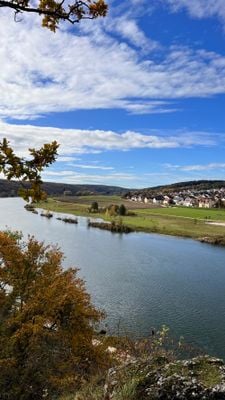
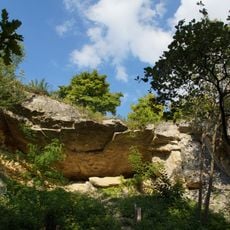
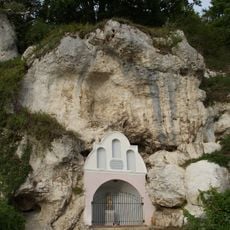
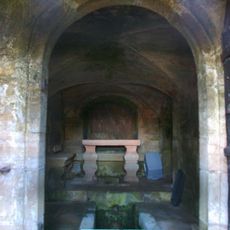
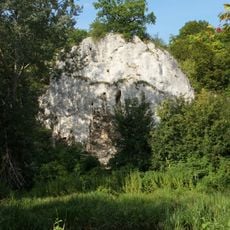
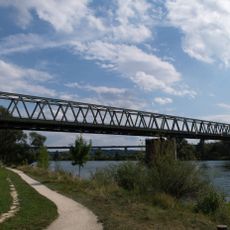
Schutzfelsen Pentling is a rock wall on the Danube about 800 metres east of Sinzing, at the southern edge of the Max-Schultze-Steig nature reserve. It is the type locality of the Schutzfels Formation, a sequence of clayey and sandy Lower Cretaceous sediments deposited in a karst hollow within Upper Jurassic limestone. The overhanging roof is Regensburg greensandstone, and in the wall lies the Schutzfelshöhle, a half-cave about 13 metres wide, 5 metres deep and 4 metres high.
The site was first documented in 1854 by geologist Carl Wilhelm Gumbel, who studied the contact zone between Jurassic limestone and the Regensburg greensandstone formation. This discovery established it as a key reference point for the regional geological stratigraphy.
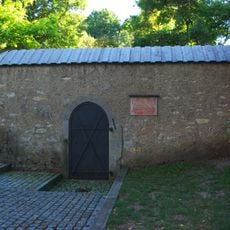
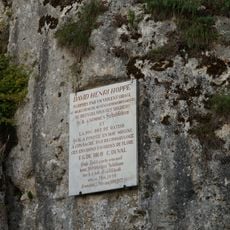
The name Schutzfelsen goes back to the botanist David Heinrich Hoppe, who sheltered under the rock overhang during a storm. On 14 May 1790 he founded in Regensburg the Regensburgische Botanische Gesellschaft, the oldest botanical society still in existence. A memorial plaque to Hoppe was placed on the rock in 1790, renewed in 1890, and is listed as a monument (D-3-75-180-22); the rock is also called Hoppefelsen.
The site is accessible via exit 45 Regensburg South on the A93 highway, followed by directional signs to Pentling. Information boards on-site explain the geological importance of this rock formation.
The sediments display an unusual color palette in bright red, violet, and blue tones, dotted with yellowish Lydite nodules and marcasite kernels. This uncommon mineral composition makes this exposure noteworthy among specialists.
The community of curious travelers
AroundUs brings together thousands of curated places, local tips, and hidden gems, enriched daily by 94,362 contributors worldwide.