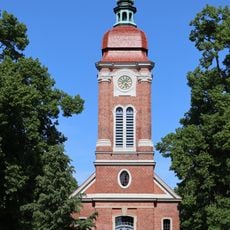
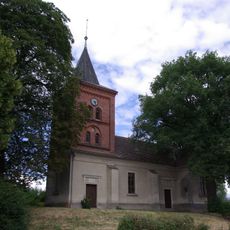
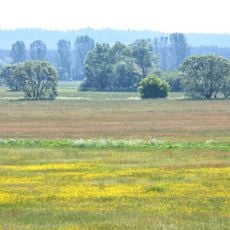
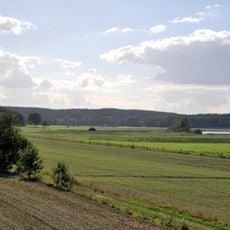
Schloss Nennhausen, Manor house in Nennhausen, Germany.
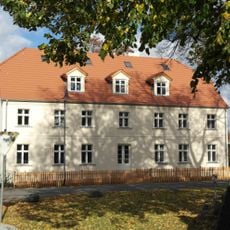
Schloss Nennhausen is a two-winged manor house with a yellow plastered facade, its main and south wings rising two storeys. A segmental-arched portal in the main wing bears a stone coat of arms of builder Friedrich Christoph von Briest, while stepped gables with turret-like pinnacles face the courtyard and park. The roofs are mansard roofs covered in red beaver-tail tiles.
The manor was built in 1705 by Georg Christoph von Briest on pre-existing foundations. From 1735 to 1738, Friedrich Christoph von Briest had it rebuilt as a three-winged Baroque complex. In the mid-19th century, Ferdinand von Arnim removed the north wing and raised the south wing, giving the L-shaped building its Neo-Tudor plaster facade. After 1945 it served as a refugee home, school, savings bank, cultural centre, kindergarten, library, municipal office and registry office.
From 1803 to 1831 the poet Friedrich de la Motte Fouqué spent his summers at the manor, married to Caroline Philippine von Briest. Guests there included Adelbert von Chamisso, August Wilhelm Schlegel, Karl August Varnhagen von Ense and E. T. A. Hoffmann. Fouqué wrote his Undine in the estate park; Hoffmann set it to music.
Schloss Nennhausen is a private residence that also serves as a cultural venue, so visits depend on events rather than fixed opening hours. The roughly 40-hectare park, restored from 1990 onward, is the main area to walk; the former orangery stands as a small converted building within it. The ensemble lies in the village of Nennhausen in western Brandenburg.
The 1983 fire destroyed the roof, and the ruin stood exposed for almost ten years before security work began in 1992. The manor was listed as a monument in 1990, while still a ruin. The von Stechow family, owners since 1997, began extensive restoration in 2001.
The community of curious travelers
AroundUs brings together thousands of curated places, local tips, and hidden gems, enriched daily by 93,717 contributors worldwide.