Viadukt Königsbrück, Railway bridge and architectural heritage monument in Königsbrück, Germany.
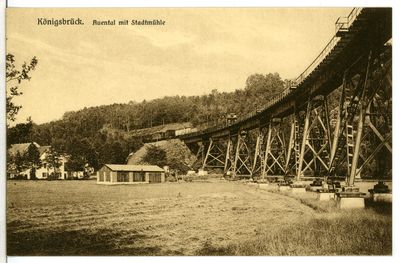
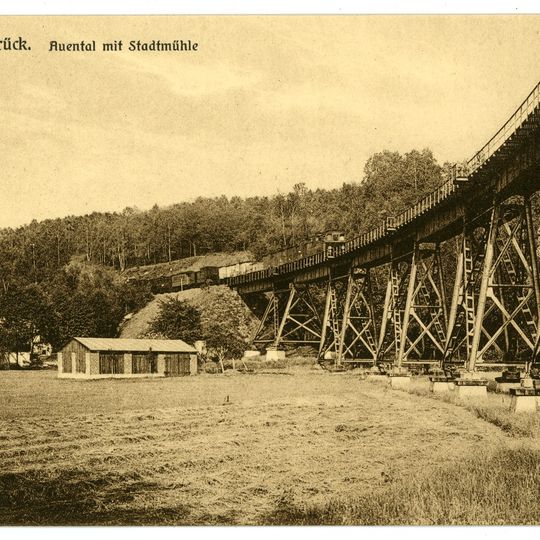
Viadukt Königsbrück is a riveted steel viaduct 214.5 metres long and 14.5 metres high, carrying the former Dresden-Klotzsche–Straßgräbchen railway over the Pulsnitz and the Mühlgraben. It runs on a curve and rests on seven steel lattice piers spaced about 19.5 metres apart. The ironwork weighs nearly 527 tonnes; the Dresden firm Kettner & Lindner built it in 1898–99 for 211,934 marks.
The viaduct was built between 1898 and 1899 for the standard-gauge Königsbrück–Schwepnitz line, opened on 30 September 1899. Dresden firm Kettner & Lindner erected the riveted steel structure; the foundation for the second pier was set on 20 October 1898. The bridge cost 211,934 marks. The line was extended to Straßgräbchen-Bernsdorf in 1933–34, and the last passenger train crossed in 1998.
The bridge has become a landmark in the local landscape that residents recognize as part of their industrial heritage. It stands protected as a historical monument and connects the community to the railway era that shaped the region.
The bridge is visible from the road and can be observed from several nearby vantage points. The structure is best viewed from below in the valley, where the arched form becomes clearly apparent.
The bridge's arched form was an engineering solution to maximize stability across the wide valley. This was a hallmark of the engineering skill of that era, still visible today in its robust construction.
The community of curious travelers
AroundUs brings together thousands of curated places, local tips, and hidden gems, enriched daily by 94,538 contributors worldwide.