Klosterkirche, Medieval church building in Oschatz, Germany.
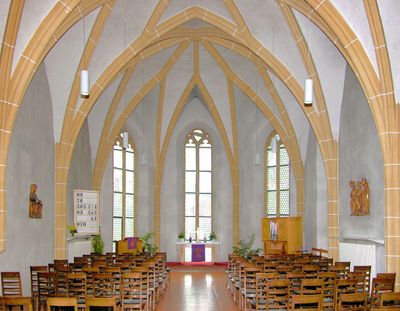
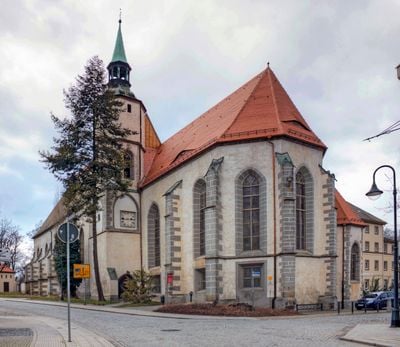
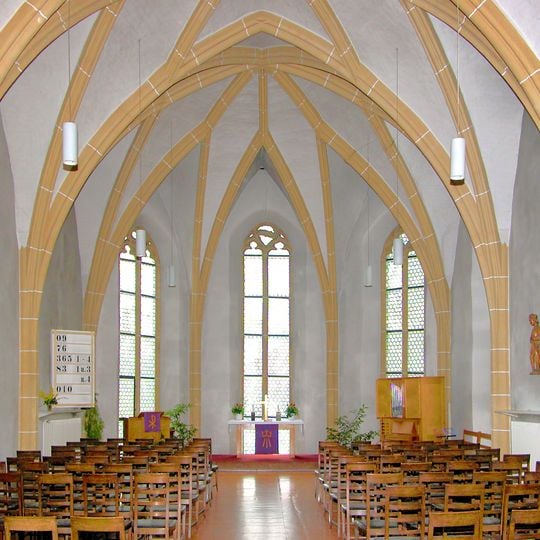
Klosterkirche is the only surviving building of Oschatz's former Franciscan monastery, built 1246–1248 and reconsecrated in 1484 after the Hussite destruction. Its exterior has a tall tower with a green copper spire and clock, pale gray stone walls, dark buttresses and tall pointed windows; inside, pale wooden ribs branch across a vaulted ceiling above rows of wooden chairs and an altar draped in purple.
Franciscan friars who arrived in Oschatz in 1228 founded a convent first documented in 1240; their church was built between 1246 and 1248 and consecrated on the Sunday before St John's Day in 1248 to the Virgin Mary. After the Hussites destroyed monastery and town in 1429, rebuilding began in 1430 and the church was consecrated again in 1484. Duke Henry dissolved the convent in 1539 during the Reformation, after which the church served as a magazine, military hospital and riding hall for the Uhlans.
The name Klosterkirche recalls the Franciscan convent founded in Oschatz in 1228 and first documented in 1240. Since 2014 the association KlosterArt Oschatz has run the building as a community centre, and the upper-floor hall, used as a winter church, holds a 1966 organ by the Jehmlich brothers.
The church is run by the KlosterArt Oschatz association, founded in 2014, and since the 2020–2022 conversion serves as a community centre. The upper-floor hall, also used as a winter church, holds a Jehmlich organ positive from 1966. Remains of the town wall are still visible in the western part of the churchyard.
The church was originally connected to a monastery that supported the religious community in the area. Today, fewer traces of that monastery remain visible, yet the church's name preserves the memory of this earlier structure.
The community of curious travelers
AroundUs brings together thousands of curated places, local tips, and hidden gems, enriched daily by 92,741 contributors worldwide.