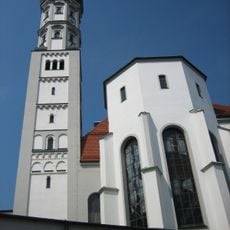
Evangelische Heilig-Kreuz-Kirche Augsburg, Protestant church in Augsburg, Germany.
Evangelische Heilig-Kreuz-Kirche is a Lutheran hall church built in 1652/53 by carpenter Johann Jakob Krauss, with a trapezoidal ground plan forced by the Augustinian canons' refusal to sell more land. Two galleries on slender Tuscan columns make the interior feel almost square. The east facade has three triangular-gabled portals, five tall arched windows above, and a six-sided turret with an onion dome.
A chapel on the Heilig Kreuz monastery site, first dedicated to St Catherine of Alexandria, was assigned to the new Protestant congregation in 1525 and enlarged from 1561, when it took the name Heilig-Kreuz-Kirche. The Protestants were expelled and the church demolished in 1630. After the Peace of Westphalia returned the site in 1648, pastor Thomas Hopfer raised funds on a year-long collecting journey, and the present church was built by Johann Jakob Krauss from 1652, consecrated on 24 October 1653.
The church has been called Europäische Friedenskirche (European Peace Church) since the 350th anniversary of its consecration in 2003. Its interior holds Baroque paintings by artists such as Johann Georg Bergmüller, whose altar fresco dates from around 1730, and a pulpit made in 1762 by Ignaz Wilhelm Verhelst after a design by Johann Esaias Nilson. A memorial plaque unveiled in 2015 on the south wall by the stair to the galleries recalls the more than 1,200 Austrian prisoners held here in 1800 and 1805.
The church stands in the northwest of Augsburg's old town, next to the Catholic Heiligkreuz-Kirche. The entrance front faces east, with three triangular-gabled portals; the interior is entered from this side. A memorial plaque from 2015 at the south wall stair to the galleries marks the use as a prisoner camp around 1800 and 1805.
The parish had no church of its own from 1630 to 1653. To fund the new building, pastor Thomas Hopfer travelled for a year from 1650, visiting Protestant courts including the Danish king and Queen Christina of Sweden, who gave most generously; by 1652 the collection held 46,407 guilders. A 2015 plaque on the south wall stair to the galleries recalls that in 1800 and after Ulm in 1805 the church held over 1,200 Austrian prisoners of war.
The community of curious travelers
AroundUs brings together thousands of curated places, local tips, and hidden gems, enriched daily by 94,229 contributors worldwide.