Gut Leidenhausen, Former farm estate in Eil, Germany
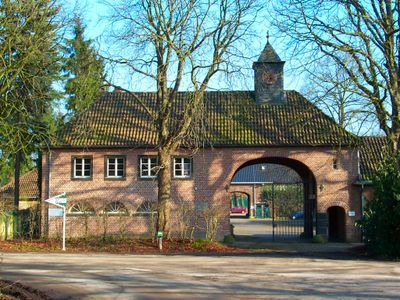
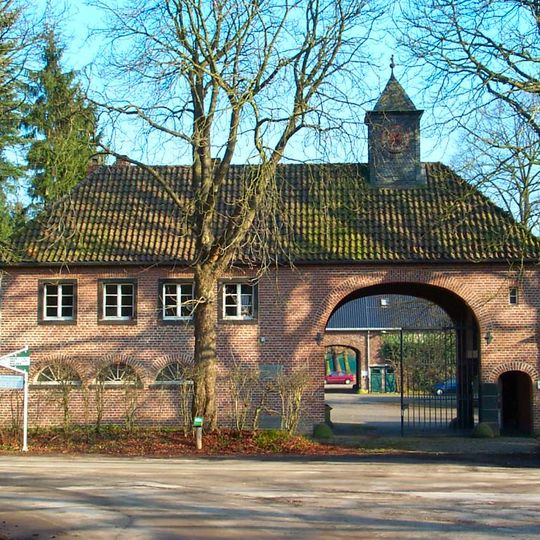
Gut Leidenhausen is a long, single-storey brick building with a steep, moss-patched tiled roof, built around a courtyard. A wide round-arched gateway with open dark metal gates and a brick surround forms the centre, with a smaller arched wooden door to its right. Six windows pierce the brick: four rectangular ones with light-blue curtains and, below them on the left, three round-arched windows. A small square clock tower sits on the roof above the gateway.
Gut Leidenhausen was first documented in 1329 as a water-enclosed knight's seat. It passed through noble families, including the von Hatzfeld in the 16th and 17th centuries and the von Mirbach-Harff in the 18th and 19th. Until 1803 it was the administrative centre for the area between Bergisch Gladbach and Siegburg. In 1963 the city of Cologne acquired the estate, which had been a large farm until 1964.
The name Leidenhausen is a place name from the 7th to 9th century meaning "the settlement or farm of an owner named Leido". Since 1982 the eastern barn wing has housed the nature museum "Haus des Waldes", whose educational room is used by the Waldschule of the Schutzgemeinschaft Deutscher Wald.
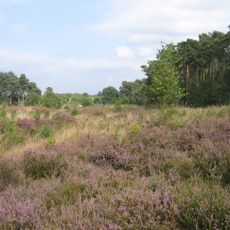
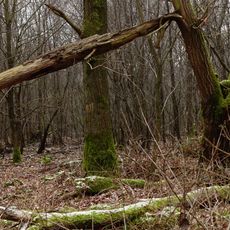
Walking and cycling paths cross through the grounds and lead to nearby woodland areas. Visitors can explore the buildings and have direct access to the Wahner Heide and Königsforst nature reserves.
The clock tower above the archway is a later addition to the farmyard: the gaps between the older buildings were filled with stables and barns around 1920 and 1930, giving the courtyard its closed form with the gateway. The estate had been a working farm until 1964, and since 1982 the eastern barn wing has housed the "Haus des Waldes" nature museum, whose teaching room is used by the Wald School of the Schutzgemeinschaft Deutscher Wald.
The community of curious travelers
AroundUs brings together thousands of curated places, local tips, and hidden gems, enriched daily by 93,236 contributors worldwide.