St. Matthäus, Lutheran church in southern Erlangen, Germany
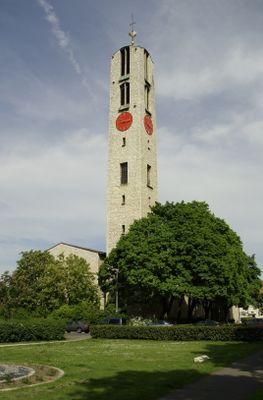
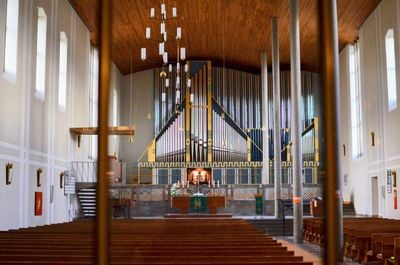
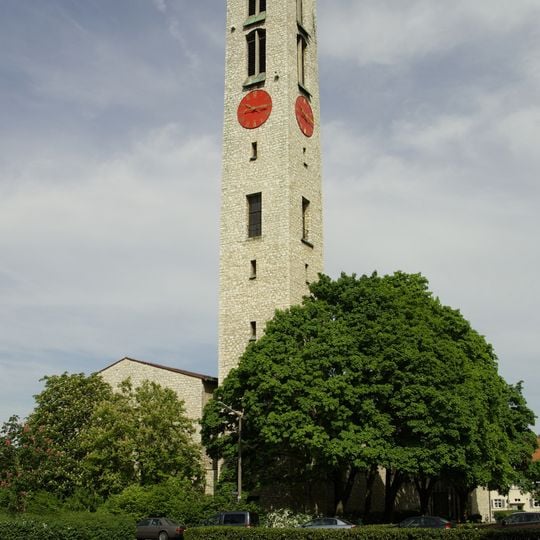
St. Matthäus is a Lutheran parish church in southern Erlangen, built from 1957 to 1960 to a design by Munich architect Gustav Gsaenger. The rectangular nave, 53 metres long and 15 metres wide, is clad in rough-hewn pale Jura limestone and has no separate chancel; the altar and organ stand several steps up at the southern end. Two flat larch-wood barrel vaults rest on six slender round columns, and a free-standing campanile with red-dialled clocks rises near the south-east corner.
Construction began in 1957 under Munich architect Gustav Gsaenger and the building was consecrated on April 3, 1960. The project arose in the postwar period to serve the growing Lutheran community in Erlangen.
The church is known as an "Oratorienkirche" because of its acoustics and is often used for concerts; the organ stands behind the altar area, leaving room for choir and orchestra. The pulpit carries a red marble relief by Erlangen sculptor Christian Wrede showing a pelican feeding its young, a symbol of Christ's love for people.
The church stands in the Röthelheimpark area of southern Erlangen, with the parish house on Emil-Kränzlein-Straße and the 1964 parish hall on Rathenaustraße enclosing a small green courtyard with the nave. The free-standing campanile rises near the south-east corner of the nave. The interior seats around 900 people on the nave floor and the double gallery on the north side.
The bell tower holds five bells that together form the largest and deepest-sounding carillon in Erlangen. The bells were cast in 1961 by the Bachert foundry in Karlsruhe and produce a particularly warm sound.
The community of curious travelers
AroundUs brings together thousands of curated places, local tips, and hidden gems, enriched daily by 94,045 contributors worldwide.