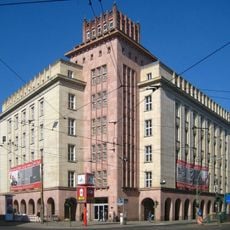
Borsighaus, Neo-Renaissance administrative building in Mitte, Germany.
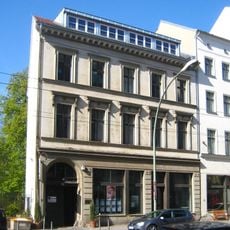
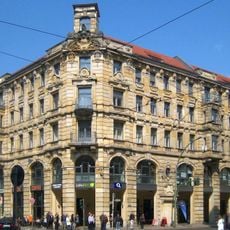
Borsighaus is a four-story sandstone building at Chausseestrasse 13, built to plans by Konrad Reimer and Friedrich Körte in Neorenaissance forms. A dominant triangular gable sits between two two-story bays topped with curved hoods, and three plain wings enclose a roughly square courtyard. A bronze blacksmith sculpture stands at the centre of the street facade, with the initials A. B. for August Borsig beneath it.
Borsighaus was built as the main office of the Berlin machine factory Borsig and completed in 1899, shortly after the Borsig works opened in Berlin-Tegel. From 1937 until the end of the 1950s the Borsig property administration had its seat here. The building survived the Second World War almost undamaged; after reunification the Berlin dental chamber's pension fund bought it and had it restored by Peter and Tobias Hübotter from 1996 to 1999.
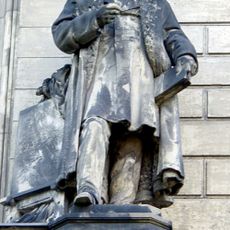
A bronze blacksmith stands at the centre of the street facade; the Berlin sculptor Gotthold Riegelmann made it, though other accounts name Gustav Blaeser and say it once stood on the water tower of the Borsig machine works. Below the figure are the initials A. B. for company founder August Borsig.
The Borsighaus stands at Chausseestrasse 13 in the Oranienburger Vorstadt, directly opposite the Brecht-Haus. It is an office building, not a museum: the Bundeszahnärztekammer, a dental practice, a law firm and a furniture showroom occupy it, so visitors should limit themselves to the entrance hall and the street facade with the blacksmith sculpture.
The blacksmith figure on the facade is attributed to Gotthold Riegelmann, though other accounts name Gustav Blaeser and say it once stood on the water tower of the Borsig machine works. Beneath the figure are the initials A. B., for company founder August Borsig.
The community of curious travelers
AroundUs brings together thousands of curated places, local tips, and hidden gems, enriched daily by 92,681 contributors worldwide.