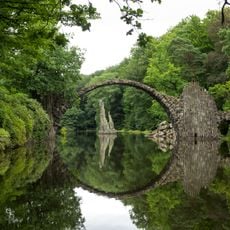
Rakotzsee, Artificial lake in Kromlau, Gablenz, Germany.
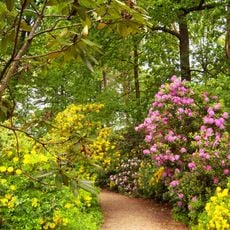
Rakotzsee is an artificial lake about 300 m long and 35 to 50 m wide in the Kromlau azalea and rhododendron park, part of Gablenz in the Görlitz district. It has no natural inflow, so its water level is kept up by a pump. In the middle, the 19.80 m Rakotzbrücke spans the water, and a basalt column group called the "Orgel" stands in the lake.
Rakotzsee was dug artificially between 1842 and 1875 as part of the Kromlau azalea and rhododendron park in the municipality of Gablenz. The ensemble of lake, Rakotzbrücke and basalt organ is regarded as an example of Romantic garden architecture. From 2018 to 2021 the water was drained for a restoration costing about 4.2 million euros; the bridge reopened on 10 July 2021.
The lake's name comes from the Sorbian word for crab, connecting it to the region's Slavic heritage. The Sorbian people shaped this landscape for centuries, and their language remains present in many local place names.
Entry to the lake and park is free with no admission charge. However, walking across the historic basalt bridge is not permitted, though many trails offer viewing points of the water and surrounding landscape.
The Rakotzbrücke spans the lake at its centre and is 19.80 m long. The lake itself is about 300 m long and 35 to 50 m wide. In 2017 the bridge served as a gateway to a parallel world in the film Der Zauberlehrling.
The community of curious travelers
AroundUs brings together thousands of curated places, local tips, and hidden gems, enriched daily by 92,728 contributors worldwide.