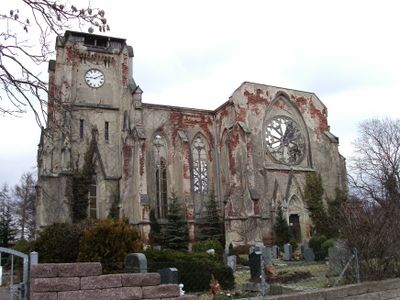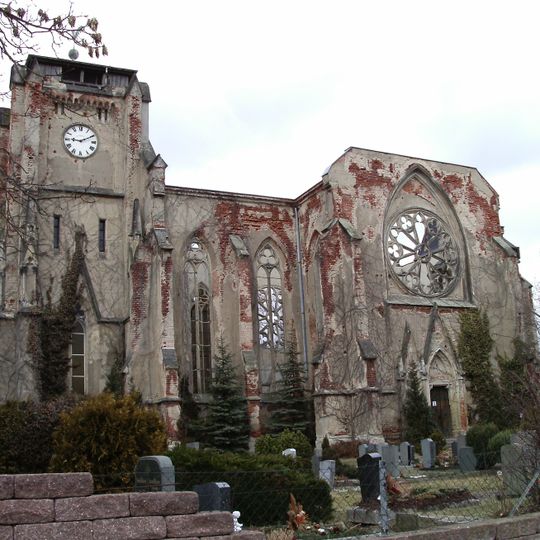
Kirchenruine Wachau, Church ruin in Wachau, Markkleeberg, Germany.
Kirchenruine Wachau is the secured ruin of a neo-Gothic church built in 1866–1867 to designs by Constantin Lipsius on a cruciform plan with a five-eighth choir. All outer walls with double-stepped buttresses stand; the nave is open to the sky with a paved floor, while the apse with a simple altar is roofed. The west portal, tall Gothic window openings with some tracery, and two large rose windows of the transept survive.
A church in Wachau was first mentioned in 1393 and belonged to Buch Monastery until the 16th century. The neo-Gothic replacement, designed by Constantin Lipsius, was built from 1866 to 1867. British air mines damaged the roof in 1943 and American incendiary bombs hit the tower and sacristy in 1945; after 1974 the tower was partly demolished and the nave vault collapsed.
Since its rededication on 11 May 1997, the secured ruin has hosted summer services, weddings, baptisms and concerts of various kinds. The painter Aris Kalaizis used it in his work "Das Martyrium des hl. Bartholomäus" as a symbol of an almost unreachable, abandoned place.
The site is somewhat off the main paths, so allow extra time for finding the location and watch for local signs. Access is limited for wheelchair users, and visitors should prepare for uneven ground and be sure-footed when exploring the ruins.
A lightning strike in 1974 hit the tower and caused its partial collapse, with debris destroying the nave's vault. This event transformed the already-damaged war building into the open ruins that exist today, creating an entirely new character for the structure.
The community of curious travelers
AroundUs brings together thousands of curated places, local tips, and hidden gems, enriched daily by 92,687 contributors worldwide.