Weiherwiesen, Protected area in Essingen, Germany.
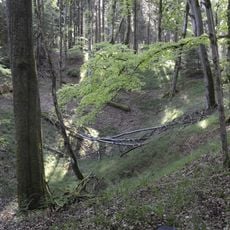
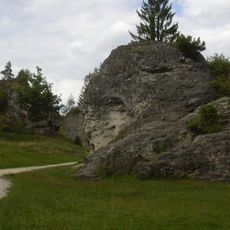
Weiherwiesen is a 27.85-hectare nature reserve between Essingen and Bartholomä on the Swabian Jura, lying at about 670 m in a basin near Tauchenweiler. It holds two ponds fed by a spring at its western edge, surrounding wet meadows, a doline, and the dry valley Weiherschlauch curving south. The ponds sit on red, clay-rich Feuersteinlehm over White Jurassic limestone.
Archaeological discoveries from the Middle Bronze Age, including burial mounds and settlement remains, show that humans inhabited this area thousands of years ago. These findings indicate a long history of human activity in the region.
The reserve protects the site partly for its cultural-historical value as evidence of sheep farming once widespread on the eastern Swabian Jura. Bronze Age burial mounds and finds in the surroundings show human presence from about 1600 to 1300 BC, and the red flint clay allowed pottery production.
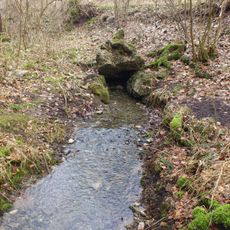
The two ponds and the dry valley lie in a basin at about 670 m between Essingen and Bartholomä, near Tauchenweiler. The spring-fed stream feeding the ponds disappears underground after a few hundred metres in a doline called Wasserfall. Ground on the wet meadows and the fireclay soil is soft, so wear sturdy footwear.
The ponds were created by damming a small stream fed by a spring at the western edge of the reserve. After a few hundred metres the water disappears into a sinkhole called Wasserfall, and dye-tracing tests showed it resurfaces at the Schwarzer Kocher spring and the Ölweiher spring in Oberkochen.
The community of curious travelers
AroundUs brings together thousands of curated places, local tips, and hidden gems, enriched daily by 94,347 contributors worldwide.