Pfarrkirche St. Magnus, Catholic parish church in Bad Schussenried, Germany
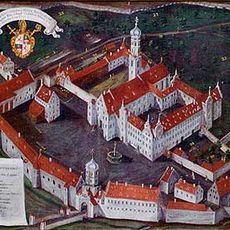
Pfarrkirche St. Magnus is a three-nave pillar basilica in Bad Schussenried whose Romanesque core, begun after the monastery's 1183 founding, remains visible in the nave. Gothic net vaults replaced the flat ceilings, and a spire crowns the tower. The west facade is fronted by the castle-like prelature added in 1482.
The church was built after the monastery of Schussenried was founded in 1183, as a three-nave Romanesque pillar basilica; completion after 1230 under Provost Konrad II is assumed. Raised to abbey church in 1440, it was enlarged under Abbot Heinrich Österreicher (1480–1505): the tower was heightened and given a spire, the flat Romanesque ceilings became Gothic rib vaults, and a new monks' choir was added. In 1482 the castle-like prelature was placed in front of the west facade.
The ceiling frescoes were painted in 1744–1746: Gabriel Weiss created the choir scenes of Norbert of Xanten and six Premonstratensian saints, while Johannes Zick painted the nave with Norbert's life and the side aisles with the legends of Magnus and Augustine. A world clock with the Holy Spirit dove spans the chancel arch.
The church stands in the centre of Bad Schussenried, its west facade fronted by the castle-like prelature added in 1482. The three-nave Romanesque nave with its pillars still shows the building's origins around 1230. Look for the late-Gothic Madonna of about 1440 by Hans Strigel the Elder on the south nave wall.
The choir stalls were crafted between 1715 and 1717 from walnut and lime wood, displaying 24 saint figures and scenes from Mary's life. These intricate carvings represent skilled craftsmanship that visitors often overlook.
The community of curious travelers
AroundUs brings together thousands of curated places, local tips, and hidden gems, enriched daily by 92,931 contributors worldwide.