St. Magnus, Religious heritage monument in Albersroda, Germany.
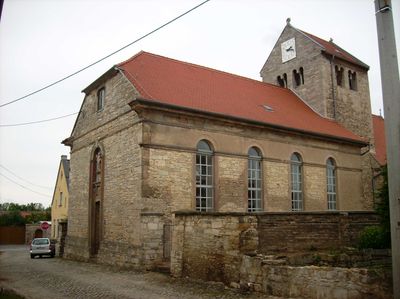
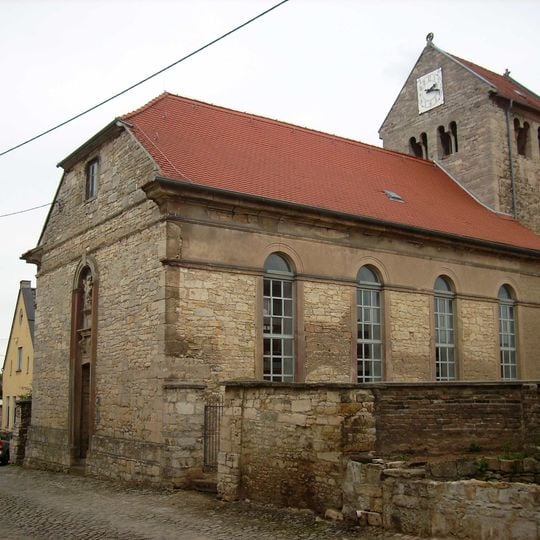
St. Magnus in Albersroda is a church whose oldest part is a tower from the 13th century, while the choir was designed in the late Gothic style. The nave was extended in 1838 in the classical style and now houses a large organ.
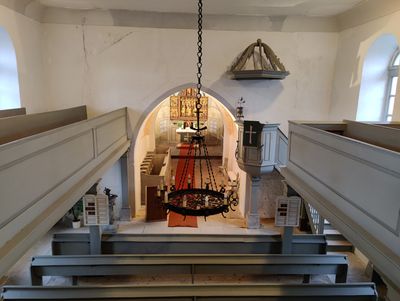
The core of the church is a late Romanesque choir tower church, of which the square tower with coupled round-arched sound openings survives. A slightly wider late Gothic choir was added, and the nave was rebuilt in 1838 in the round-arch style. Friedrich Ladegast of Weißenfels built the organ in 1851 as his Opus 7; it was enlarged by two registers in 1875 and restored in 2001 and 2005.
The main altar, carved in the early 16th century, shows a Madonna crowned by two angels between Saints Catherine and Barbara, with six apostles on each wing. Its slender figures and mountain landscapes point to a pupil of Lucas Cranach the Elder. A second, smaller carved altar from the same workshop stands on it, showing Anna selbdritt.
Access to the church is available during regular opening hours, and the interior provides enough space to walk around and view the different areas. It is advisable to allow time to examine the ornaments and details, especially if you want to explore the organ and carved elements more closely.
The tower's domed vault is pierced by large pointed arches to east and west, so the space reads as a passage rather than a closed chamber. In the bell storey above, coupled round-arched sound openings survive from the late Romanesque original; the three iron bells cast in 1964 hang there on cranked yokes with counterweight clappers, sounding a'–c''–d''.
The community of curious travelers
AroundUs brings together thousands of curated places, local tips, and hidden gems, enriched daily by 93,230 contributors worldwide.