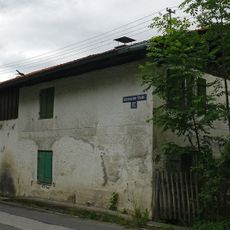
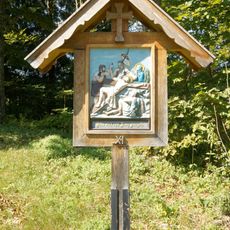
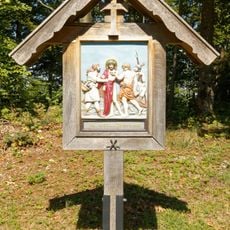
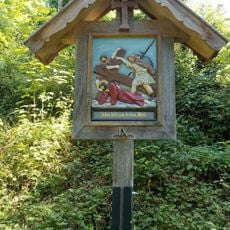
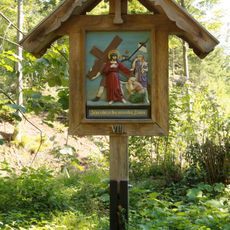
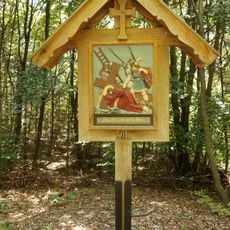
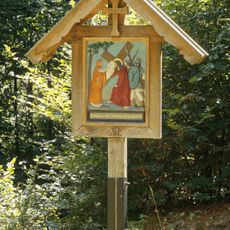
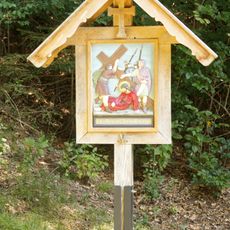
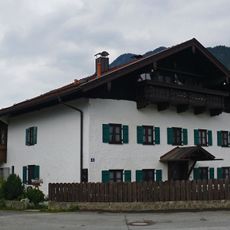
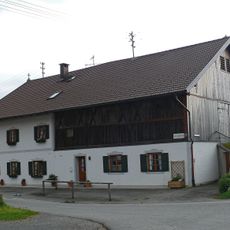
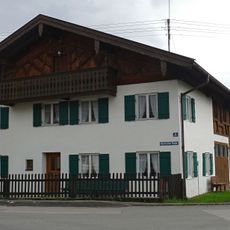
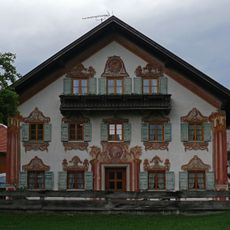
Schloss Wengwies, Architectural heritage monument in Eschenlohe, Germany.
Schloss Wengwies is a historicist manor house built in 1902 by the architects' office Jack & Wanner for Fritz von Stetten, who came from an Augsburg patrician family. It stands in Wengwies, a hamlet of Eschenlohe in the Garmisch-Partenkirchen district, and is listed as a Bavarian monument (D-1-80-114-17).
Wengwies first appears in the Ettaler Salbuch of 1335 as two half-farms of the Ettal monastery, the Wastl and Hauser holdings. Count Hermann von Stainlein-Saalenstein bought the hamlet in 1879; Fritz von Stetten, from an Augsburg patrician family, then acquired it and had Jack & Wanner build the castle in 1902. After World War I it passed to textile entrepreneur Fritz Rechberg of Bad Hersfeld, whose brother Arnold, a sculptor and anti-Bolshevik publicist, lived there for a time. It remains with the Rechberg family.
Wengwies began as two half-farms of the Ettal monastery, recorded in its first Salbuch of 1335. After 1918 the estate passed to the textile manufacturer Fritz Rechberg of Bad Hersfeld, whose brother Arnold, a sculptor and anti-Bolshevik publicist, lived there for a time. The Rechberg family still owns the castle.
The building sits in a quiet village setting in the Alpine foothills and is easily accessible from the town center. Visitors should allow time to view the exterior and surrounding landscape at a leisurely pace.
A member of the owning family was himself a noted sculptor and political writer who used the house as a hub for artistic activities. His works and writings connected the private residence to the broader cultural scene of his era.
The community of curious travelers
AroundUs brings together thousands of curated places, local tips, and hidden gems, enriched daily by 94,639 contributors worldwide.