Village church Glienicke, Octagonal church in Heiligengrabe, Brandenburg, Germany
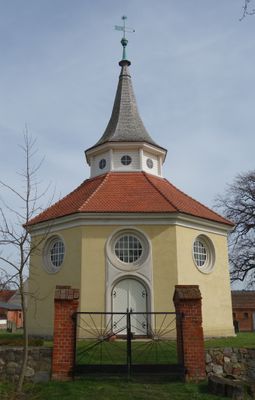
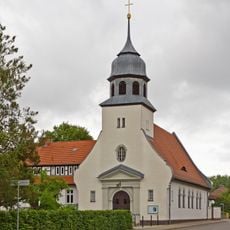
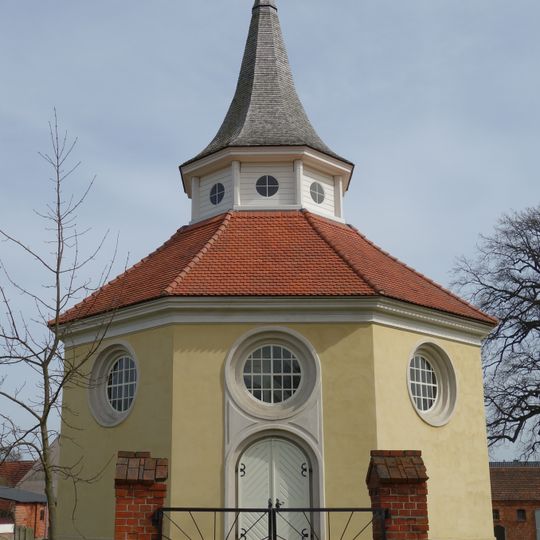
The Dorfkirche Glienicke is an octagonal central building with pale yellow walls, a red tiled roof and a grey shingled spire. A white upper section with three round windows sits below the roof; the front facade has a large round window with a white frame and grid above a white double door, flanked by two smaller round windows. Two capped brick pillars with black metal gates stand in front.
Glienicke's medieval fieldstone church, already in disrepair by 1809, was replaced by a new building. The Wittstock building inspector Friedrich Buchholtz submitted a plan in 1813, which Karl Friedrich Schinkel rejected at the Oberbaudeputation in Berlin; his counter-design of 7 March 1814 became the first octagonal church built to his design, erected 1815–1817. The attribution to Schinkel was confirmed in 2012.
The village was first mentioned in the late 13th century and was destroyed in 1420 by Mecklenburg raiders; the parish it serves belongs to the Wittstock-Ruppin church district. Two tin candlesticks from 1652 and 1653, inscribed "Zu Glinike", survive from the predecessor church and were probably donated for its consecration.
The building is accessible on foot and can be viewed from outside at any time since it is not fenced. Those interested in exploring the interior should check whether the door is unlocked during visiting hours or inquire beforehand.
Glienicke is the site of Karl Friedrich Schinkel's first octagonal church: he rejected the local inspector Buchholtz's rectangular design in March 1814 and drew a central-plan alternative. The attribution was only proven in 2012 from the Oberbaudeputation files in Berlin.
The community of curious travelers
AroundUs brings together thousands of curated places, local tips, and hidden gems, enriched daily by 93,692 contributors worldwide.