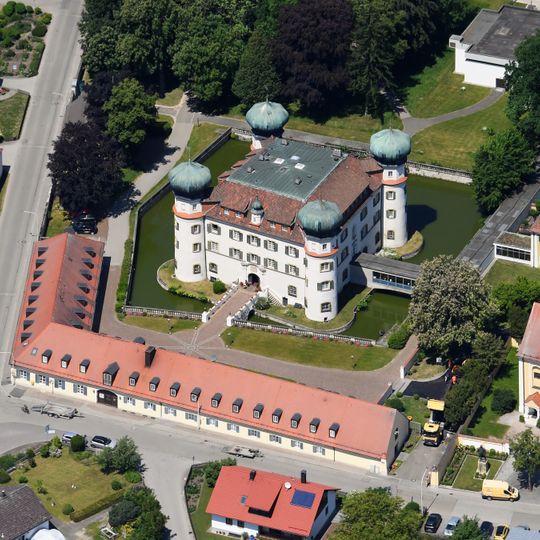
Schloss Offenstetten, Medieval castle in Offenstetten, Germany
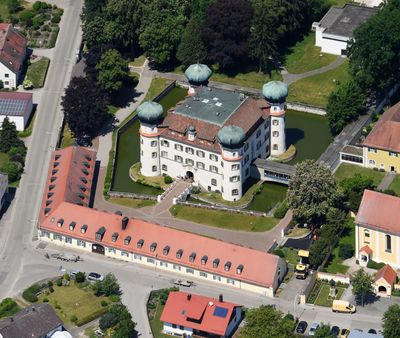
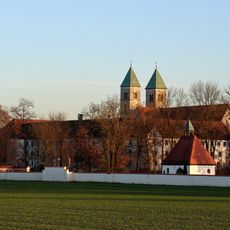
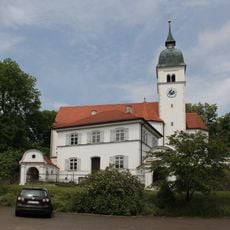
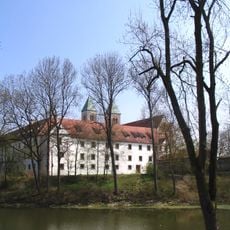
Schloss Offenstetten is a three-story four-wing building with three-quarter-round corner towers that taper slightly and end in a polygonal fourth story with onion domes. A small domed roof turret in the south marks the site of the castle chapel, abandoned in 1877. The moat and castle park survive, and two economic wings south of the castle date from the 17th–18th centuries.
The Lords of Offenstetten are documented from 1097/98, when Aribo de Ouinstetin donated property to Weltenburg Abbey. The line ended with Jörg, an illegitimate son of Degenhart, last mentioned in 1493; the widow's marriage to Wolfgang Schmiechen produced no heirs, and Offenstetten was sold to the Preysing brothers. The medieval moated castle was destroyed in the Thirty Years' War, and Georg Caspar Emmanuel von Frönau built the present palace between 1694 and 1696.
The castle chapel, indicated by the small domed roof turret on the south side, was dissolved in 1877. The building later served as a school and today houses a special-needs education centre. The 1921 conversion added a large staircase and several halls, while early and late 18th-century stucco work survives in some rooms.
The grounds now function as a specialized center providing education and support for children and young people with special needs. Visitors should check in advance whether tours are available, as the building operates as an educational and support facility.
Napoleon Bonaparte visited the castle on April 20, 1809 during one of his military campaigns in the region. This brief stop is an often overlooked detail that highlights the site's historical importance for Bavarian elites.
The community of curious travelers
AroundUs brings together thousands of curated places, local tips, and hidden gems, enriched daily by 94,355 contributors worldwide.