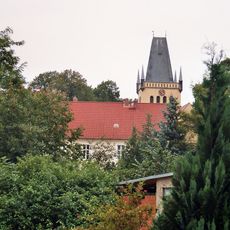
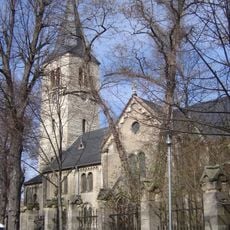
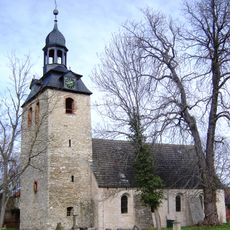
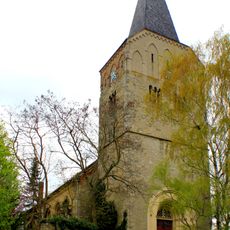
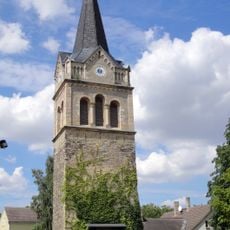
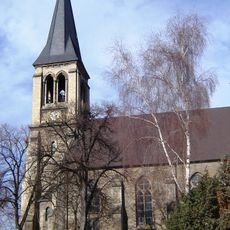
St. Sebastian, Church ruin in Bisdorf, Borne, Saxony-Anhalt, Germany
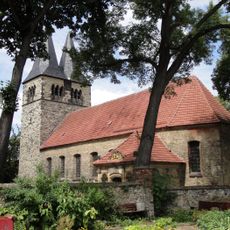
St. Sebastian in Bisdorf, part of Borne, consists of a Romanesque west tower and a nave with a wooden barrel vault, now a ruin. The tower, over 1,000 years old, is about 7.55 m wide and 5 m deep, with two opposing round arches of double wedge stones in its lower east and west walls. The nave roof collapsed at the tower in summer 2021.
The Romanesque west tower dates from the 10th-century Ottonian Christianization; the nave was demolished in 1712 and the new one consecrated in 1717. The tower was heightened during the 1712–1717 works. The church has stood empty since at least 1970, when its demolition was decided but never carried out. In summer 2021 the nave roof collapsed onto the tower after about 310 years.
The name St. Sebastian dates only from the 1712–1717 rebuild, when the parish adopted it as a confession of allegiance to the St. Sebastian monastery in Magdeburg, its patron. The congregation remained Protestant, yet in the mid-20th century the Catholic community of the Paderborn diocese used the church too, so Catholic parish life shaped a Protestant building until it was closed in the 1970s.
The church stands in the village center of Bisdorf, part of Borne. The nave roof collapsed in summer 2021, so the ruin is unsafe to enter. The adjacent Richterhöfe are privately owned and being converted; two building permits were approved in March 2021, but no plans exist for the church.
The nave roof collapsed onto the tower in summer 2021 after roughly 310 years, leaving the ruin open to the sky. In March 2019 a group of photographers lit the building by full moon and published the images online, prompting questions about how the heritage site is handled.
The community of curious travelers
AroundUs brings together thousands of curated places, local tips, and hidden gems, enriched daily by 94,457 contributors worldwide.