Mariaort railway bridge, Railway bridge in Mariaort, Germany
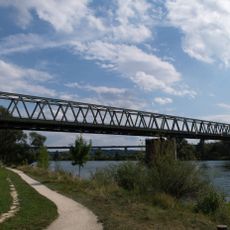
The Mariaort railway bridge is a steel structure with stone supports that crosses the Danube between Regensburg and Sinzing. The construction combines metal framework with masonry elements in a style typical of 19th-century railway engineering.
The bridge was planned and built from 1870 to 1872 by the Maffeischen Werkstätten in Regensburg for the Actiengesellschaft der bayerischen Ostbahnen, with piers already sized for two tracks. The last 44 km of line over the bridge to Regensburg station opened on 1 July 1873. The span was widened to double track between 1894 and 1896, and the original wrought-iron lattice girders were replaced in 1926 by steel fishbelly girders. USAAF bombers hit the bridge on 16 April 1945; a provisional rebuild followed, and the final reconstruction was finished in 1950, when electric operation began.
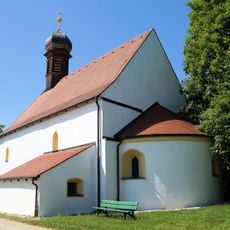
The walkway on the downstream side ends above the pilgrimage church of Mariaort, reached by a long staircase, so the crossing is used by walkers but not cyclists. The bridge stands just before the Naab flows into the Danube at kilometre 2385.67, and the route over it was opened on 1 July 1873.
A walkway runs along the downstream side of the bridge, but it ends above the Mariaort pilgrimage church at a long staircase, so cyclists should dismount or use another route. The clearance under the main spans is 8.65 m above the highest navigable water level. The bridge stands at Danube kilometre 2385.67, just before the Naab flows in.
The bridge's three 65-metre main spans use two different truss types: the southern track runs on fishbelly girders, while the northern track and the walkway rest on parallel-chord trusses. The walkway on the downstream side ends above the Mariaort pilgrimage church, reached by a long staircase, so cyclists must dismount.
The community of curious travelers
AroundUs brings together thousands of curated places, local tips, and hidden gems, enriched daily by 94,366 contributors worldwide.