Luitpoldbrücke, Steel arch bridge in Bamberg, Germany
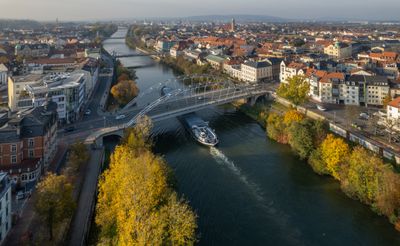
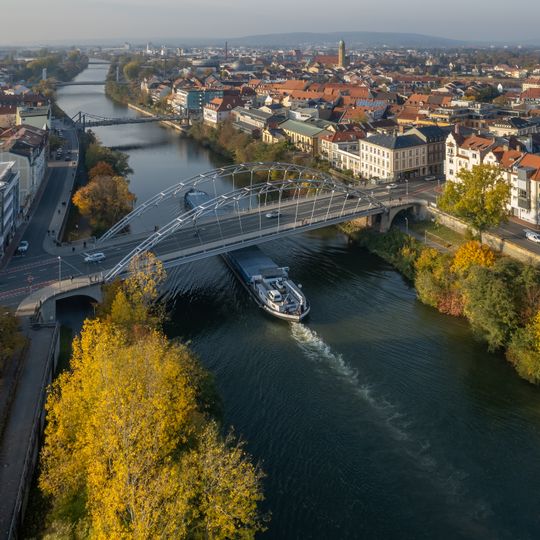
The Luitpoldbrücke is a 101 m long, 21.2 m wide steel arch bridge over the right arm of the Regnitz, part of the Main-Danube Canal, linking Willy-Lessing-Straße with Luitpoldstraße. Its two roughly 14 m high arches are slightly offset because the bridge crosses the canal diagonally; the deck hangs from 14 radial round-steel hangers per arch. The 80 m span over the canal is flanked by 10.5 m reinforced-concrete half-shell passages for the towpaths.
The first bridge here was the Sophienbrücke, opened in 1867 and named after Sophie in Bayern, Ludwig II's fiancée. Its engineer Heinrich Gerber used his patented Gerberträger here for the first time. Replaced in 1932, the bridge was blown up days before the end of World War II; the postwar concrete bridge, damaged by 2004, was demolished in April 2005 and replaced by the steel arch bridge built in 2005–2006 to plans by Richard J. Dietrich.
The bridge is named after Luitpold of Bavaria, Prince Regent from 1886 to 1912. Its predecessor, the 1867 Sophienbrücke, honoured Sophie in Bavaria, the fiancée of King Ludwig II. Since 2019 a plaque at the eastern end commemorates Heinrich Gerber, whose Gerberträger was first used on that earlier bridge.
The bridge carries three traffic lanes, marked cycle lanes and 3 m wide footways on both sides, so pedestrians cross beside moving traffic rather than in a car-free zone. It links Willy-Lessing-Straße with Luitpoldstraße, joining the city centre to the railway station. Boats pass beneath at Main-Danube Canal kilometre 5.373, where clearance is 7.80 m.
The 1867 Sophienbrücke on this site was the first bridge in the world to use Heinrich Gerber's patented Gerberträger, a hinged beam system that was soon adopted worldwide. A memorial plaque to Gerber was reinstalled at the bridge's eastern end in 2019.
The community of curious travelers
AroundUs brings together thousands of curated places, local tips, and hidden gems, enriched daily by 92,772 contributors worldwide.