Kaolinsee, Artificial lake in Hohburg, Germany
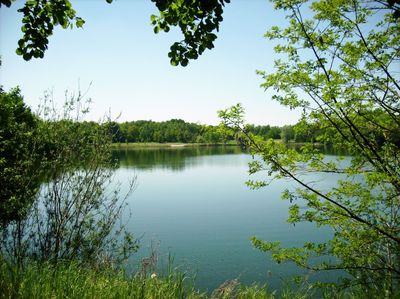
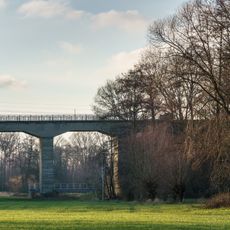
Kaolinsee is an artificial lake near Hohburg, in the Lossatal municipality, created from a flooded kaolin pit. It covers 8.3 hectares and is split by a roughly 40-metre narrows into a larger northern basin and a smaller southern one. A 20-metre bridge, renewed in 2010 and named Hedwigsfreude after the former kaolin works, spans the narrows; kaolin remnants lie nearby. A bungalow settlement stands on the northwest shore of the northern basin.
Kaolin mining started in 1901 under Baron Adolf von Schönberg and continued for decades with large-scale extraction operations. After 1964, water gradually filled the abandoned pit, creating the lake that exists today.
Local residents call the water 'de Kali' or 'de Grube' in their regional dialect, keeping the mining past alive in everyday speech. These names reflect how deeply the area's extraction heritage shaped the identity of people here.
A parking lot sits on the K 8312 road between Hohburg and Kleinzschepa along the north shore. A loop trail circles the lake in about 1.8 km, or 400 m less if you cross the Hedwigsfreude bridge over the narrow passage. The western shore, outside the Hohburger Berge protected area, holds the beach and lawn.
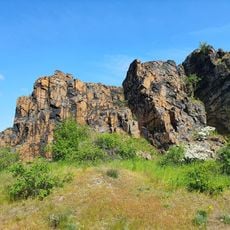
The narrow passage between the two lake halves is crossed by a 20-metre bridge renewed in 2010 and named Hedwigsfreude after the former kaolin works; lumps of kaolin can still be seen near it. The lake lies in the Hohburger Berge protected landscape except for its western shore.
The community of curious travelers
AroundUs brings together thousands of curated places, local tips, and hidden gems, enriched daily by 92,742 contributors worldwide.