Klinikum Kolkwitz, Medical heritage monument in Kolkwitz, Germany.
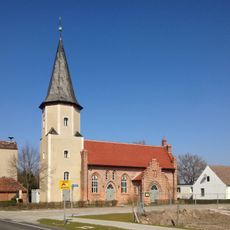
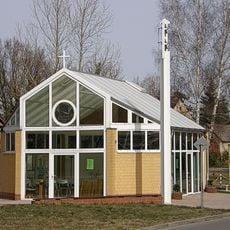
Klinikum Kolkwitz is a former tuberculosis sanatorium in Kolkwitz, Brandenburg, built between 1898 and 1900 to designs by Theodor Goecke. The three-storey brick buildings with half-timbered sections and hipped roofs are mostly Neo-Gothic; the main building has two octagonal towers with a visible clock on the garden side, and a square chapel with ribbed vaulting adjoins the courtyard.
The Brandenburg regional insurance institute built the sanatorium on land donated by Cottbus, with the foundation stone laid on 2 August 1898 and inauguration on 13 June 1900. It initially offered 65 beds for women textile workers. In the 1950s, with about 300 beds, it was the largest tuberculosis sanatorium in East Germany. After tuberculosis declined, it became a rehabilitation clinic in 1972.
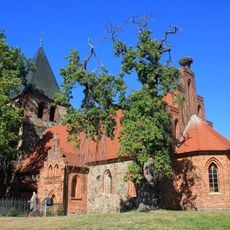
The chapel attached to the courtyard has a cross-ribbed vault and a semicircular apse with pointed-arch windows; Bible verses about illness are carved into the door frames, such as "Ich bin krank". The garden side is flanked by two octagonal towers with cupolas and lanterns, one holding a clock. The park was laid out by Georg Bleyer, who also worked on the Branitzer Park.
The site is a listed monument and has stood empty since the orthopaedic department moved to Cottbus in December 2007. The association Urb Explorer, founded in 2010, organises photography tours of the ruins by prior registration. A fire destroyed much of the roof truss of an outbuilding on 21 October 2021, so parts of the grounds may be off-limits.
Almost every corner and edge inside the building was rounded to stop germs from collecting, and strict cleanliness rules applied. The courtyard side has a square chapel with a cross-ribbed vault and a semicircular apse; Bible verses about illness are carved into the door frames.
The community of curious travelers
AroundUs brings together thousands of curated places, local tips, and hidden gems, enriched daily by 94,225 contributors worldwide.