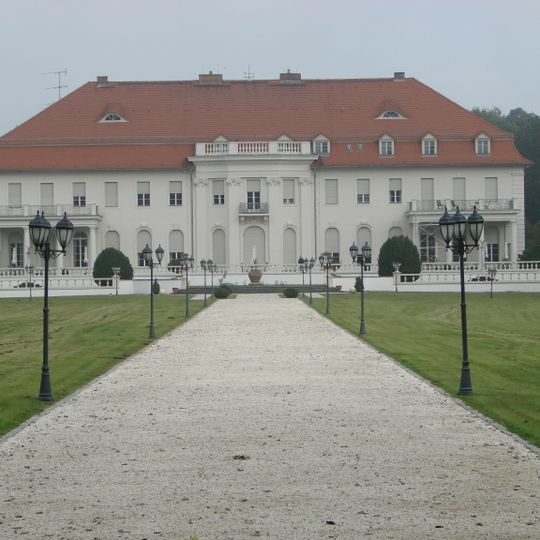
Schloss Bärenklau, Manor house in Schenkendöbern, Germany.
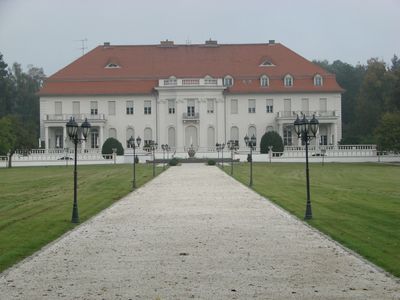
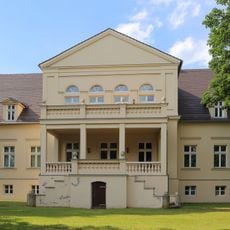
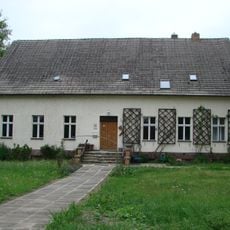
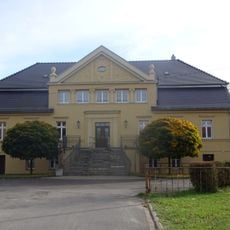
Schloss Bärenklau is a manor house in Schenkendöbern featuring a neo-baroque three-wing layout with mansard roofs, high arched windows, and a portico with Corinthian capitals at the entrance. The building displays classical architectural details across multiple levels characteristic of early 20th-century manor design.
The Bärenklau estate was first documented in 1295 and passed through 37 different families between 1517 and 1917. In May 1926 the retired cavalry captain and cloth manufacturer Ernst C. Lehmann from Guben bought it for 45,000 Reichsmark and had a country house built on the grounds between 1928 and 1930, designed by Alfred Breslauer with Paul Salinger. Lehmann fell in World War II; his family was expropriated after 1945 and the land redistributed. The house then served the FDGB as a trade union school from 1950 to 1955, later as a training home for the postal union, and from 1956 as the "Georgi Dimitroff" recovery home.
The manor serves as a center for art exhibitions and cultural presentations, hosting contemporary artistic expressions in its historic rooms. Visitors can experience rotating exhibitions that bring fresh creative energy to the building.
The manor is located about 25 minutes from Cottbus and is accessible in under two hours from Berlin, making it convenient for day trips. Group tours are available for parties of 20 or more and should be arranged in advance.
The tympanum above the entrance once held the builder's coat of arms, which is no longer there. The south side has fifteen axes and a slightly curved three-axis central risalit with four pilasters, topped by a solid balustrade. Inside, a hall with a staircase leads to the garden hall behind it.
The community of curious travelers
AroundUs brings together thousands of curated places, local tips, and hidden gems, enriched daily by 94,534 contributors worldwide.