Protestant Church, Protestant church building in Merseburg, Germany.
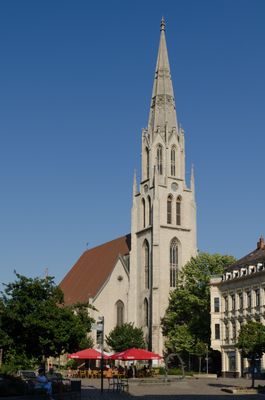
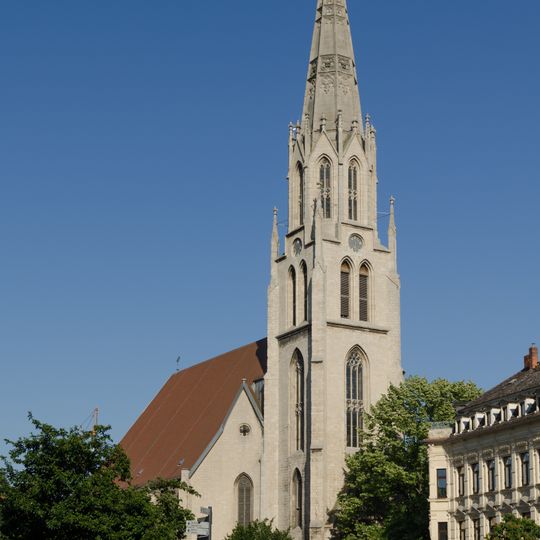
St. Maximi is a late Gothic hall church of pale masonry in Merseburg, built as a three-aisled, four-bay nave with buttresses between 1432 and 1501. A short choir the width of the central nave was added in 1485. The Romanesque west tower was replaced in 1867–1872 by a tall neo-Gothic spire with corner buttresses, an octagonal gable stage and a steep stone spire, designed by Friedrich August Stüler.
Founded in the 10th century and first documented in 1247, the church was rebuilt as a three-aisled hall church between 1432 and 1501; the short choir is inscribed 1485 and the rib vaults were installed 1494–1501. The Romanesque west tower, offset from the nave axis, was replaced in 1867–1872 by a neo-Gothic tower designed by Friedrich August Stüler, and the nave was extended one bay westward. Restorations followed in 1867–1876, 1901 and 1972/1973.
The church's name refers to Maximus of Alexandria, a rare patronage. Inside, the pulpit and altar were removed in 1972 and replaced by a carved altarpiece from the Sixti Church, showing the Madonna with Saints Catherine and John the Evangelist, with eight female saints on the wings. The organ by Friedrich Gerhardt dates from 1876 and has 47 stops on three manuals and pedal; it was restored between 2015 and 2020 by Christian Scheffler.
The south portal, walled up in the 19th century, was reopened in 1998 and serves as an entrance; the nave was extended one bay westward when the tower was rebuilt. Inside, the first eastern pair of piers survives from the predecessor building, while the following octagonal piers carry mask heads at capital height. The organ by Friedrich Gerhardt (1876, 47 stops) was restored by Christian Scheffler between 2015 and 2020.
The church's name honours Maximus of Alexandria, a rare patronage in Germany. Inside, look for two mask consoles flanking the reopened south portal, carved in the mid-15th century, and mask heads at the capitals of the octagonal nave piers. The 1876 Friedrich Gerhardt organ, with 47 stops on three manuals and pedal, was restored by Christian Scheffler between 2015 and 2020.
The community of curious travelers
AroundUs brings together thousands of curated places, local tips, and hidden gems, enriched daily by 94,354 contributors worldwide.