Petralona cave, Show cave in Chalkidiki, Greece
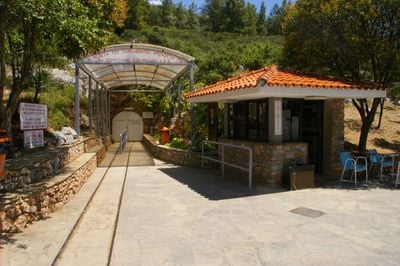
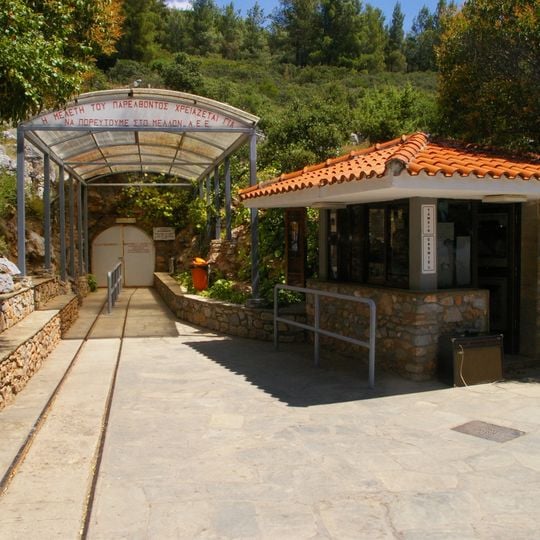
Petralona cave is a karst cave on the western slope of Mount Katsika, about 1 km from the village of Petralona. Its entrance is a 100-metre artificial tunnel built in 1974 that encloses the old natural entrance. Inside, the route passes chambers with stalactites, stalagmites and stalagnates, and one hall has a ceiling formed by white marble deposits.
The cave was discovered in 1959 by a local shepherd, leading to excavations that uncovered stone tools from the Paleolithic period. These findings revealed that humans inhabited the area from ancient times.
The Petralona skull, classified as Homo heidelbergensis, is one of Europe's most complete fossil human crania, missing only part of the front teeth. Published dates range from 150,000 to 250,000 years ago, though its morphology may point to 250,000–300,000 years. It was found on 17 September 1960, stuck 23 cm above the floor and covered by a stalagmite.
Visitors can take guided tours through the interior where excavation findings and fossil remains are displayed. Wear comfortable shoes since the paths are uneven and include some steps to navigate.
Scientists identified remains of more than 50 different animal species within the cave, including extinct bears, hyenas, lions, and panthers. This diversity reveals that various predators used the shelter over many generations.
The community of curious travelers
AroundUs brings together thousands of curated places, local tips, and hidden gems, enriched daily by 92,800 contributors worldwide.