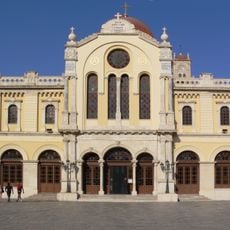
Agios Marcos, Medieval church in Heraklion, Greece.
Agios Marcos is a three-aisled basilica with a raised central nave, built in Gothic style in 1239. A portico stands before the entrance on the west facade, and two of the four buttresses added to the north wall in the 16th century survive. The bell tower that once had a flat, crenellated top and a clock was replaced by a minaret after 1669; the minaret's ruins remain to the south.
Agios Marcos was begun in 1239, after Venice took Crete following the Fourth Crusade; the Latin bishop of Ierapetra laid the foundation stone. It served the duke and high officials, who were buried there, and ducal decrees were announced at its entrance. Earthquakes damaged it in 1303, 1508, 1564 and 1595, and buttresses were added to the north wall. After Candia fell in 1669, Defterdar Ahmet Pasha turned it into a mosque until 1915; the minaret was demolished in 1924 and restoration began in 1956.
The church belonged not to the Latin archbishopric but to the Duke of Candia, who appointed a primikirios or chaplain to run it; ducal decrees were announced at its entrance and officials took their oaths of office there. Members of the ducal family were buried inside. The Ottomans later destroyed the frescoes and tombs, throwing out the bones, and installed a mihrab and minbar.
The basilica stands on Nymfon Street, just off Eleftheriou Venizelou Square in central Heraklion, and is reached on foot through the pedestrian centre. It now houses the Museum of Visual Arts, so it is visited as a gallery rather than a functioning church. Two of the four buttresses added to the north wall in the 16th century still stand and can be seen from outside.
The name honours Saint Mark, the patron saint of Venice, reflecting the deep historical ties between Crete and the Venetian Republic. This dedication reveals how foreign powers left their mark through religious naming choices.
The community of curious travelers
AroundUs brings together thousands of curated places, local tips, and hidden gems, enriched daily by 93,344 contributors worldwide.