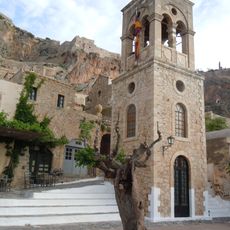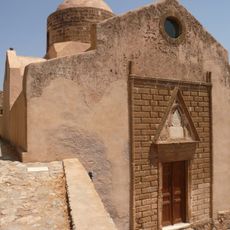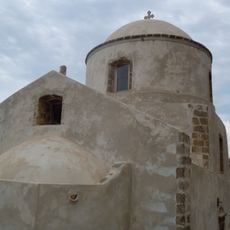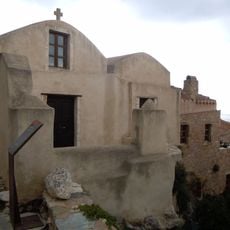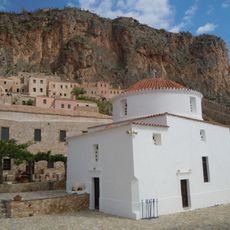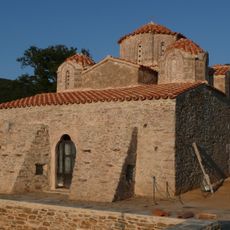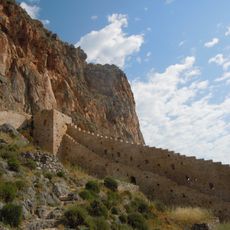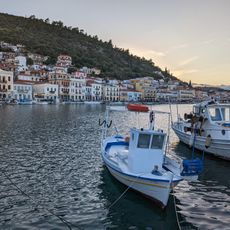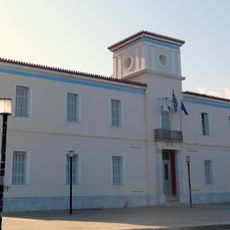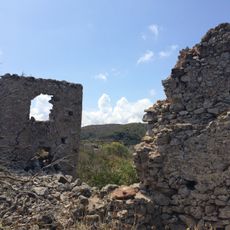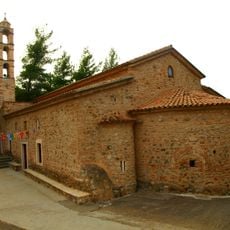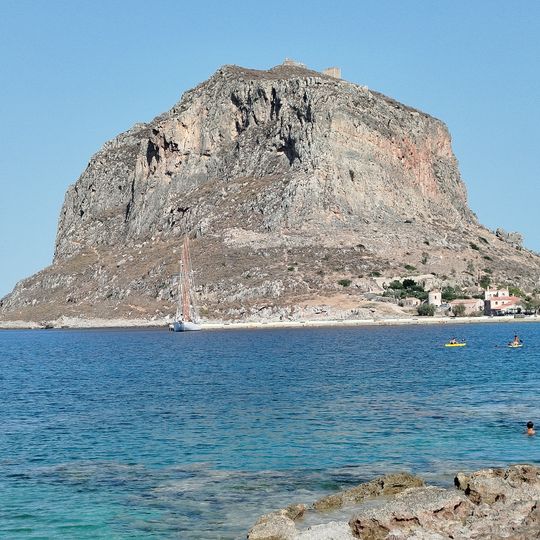
Church of Agia Sofia, Byzantine church in Monemvasia, Greece.
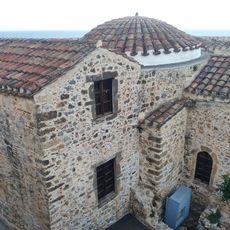
The Church of Agia Sofia is a cross-in-square Byzantine church topped with a dome, built on the upper town of Monemvasia. Its main room measures 14 by 14 metres, and the dome, seven metres in diameter, has sixteen windows. Eight pillars pushed to the sides leave the nave a single space, with chapels in the four corners, a three-sided chancel to the east and a two-storey narthex to the west.
Hagia Sophia dates to around 1150, when Monemvasia was expanding across the rock after repelling the Normans in 1147. It was first dedicated to Panagia Hodegetria. Under the first Venetian rule (1463–1540) it passed to Catholic clergy; in the first Ottoman period (1540–1690) it became the Fethiye Mosque, with frescoes whitewashed and a minaret added. It was a Catholic monastery church again in 1690–1715, a mosque until 1821, then rededicated to Holy Wisdom.
Originally dedicated to Panagia Hodegetria, the church was renamed Hagia Sophia, Holy Wisdom, after 1821, when the minaret was demolished and Christian worship restored. Its 12th-century chancel frescoes show scenes from the life of Saint Nicholas, linked to the relics taken by Italian merchants from Myra in 1087 and carried through Monemvasia's harbour on the way to Bari.
The church stands on the upper town of Monemvasia, reached on foot through the medieval settlement; the climb involves stairs and narrow passages. Wear sturdy shoes and allow time for the ascent, especially in warm weather. The main room measures 14 by 14 metres, so the interior is compact.
Layers of wall paintings visible inside reveal how religious artwork was painted over and later uncovered as the building changed hands. These visual traces tell the story of the site's religious transformations more directly than written history alone.
The community of curious travelers
AroundUs brings together thousands of curated places, local tips, and hidden gems, enriched daily by 93,795 contributors worldwide.