Rue de Rivoli, Commercial street in central Paris, France
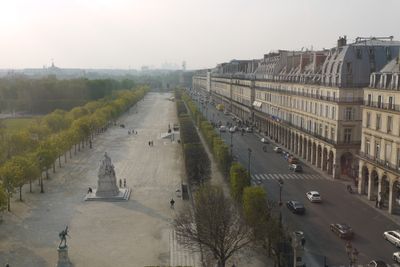
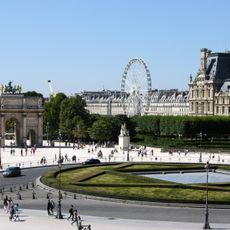
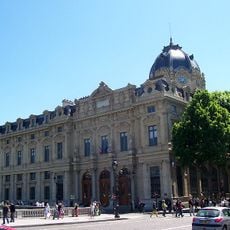
Rue de Rivoli runs about 3 km from the rue de Sévigné to the Place de la Concorde, forming part of a great Haussmannian east-west axis across central Paris. Its north side is lined for much of its length by a continuous arcade of round arches designed by Percier and Fontaine, with stone facades, iron balconies and slate mansard roofs above. The roadway is about 20.85 m wide.
The first section was opened from 1802 under Napoleon, who named the street after his victory at Rivoli in 1797; Percier and Fontaine set its width at 20.85 m. Charles X and Louis-Philippe continued it eastward from the Louvre, and Haussmann completed the stretch to the Marais between 1849 and 1855.
The name honours Napoleon's victory over the Austrians at Rivoli in January 1797. At Place des Pyramides stands the gilded statue of Joan of Arc, near where she was wounded in 1429 attacking English-held Paris. A plaque at no. 144 marks the killing of Huguenot leader Admiral de Coligny in the St. Bartholomew's Day massacre of 1572.
The street runs 3 km from the rue de Sévigné to the Place de la Concorde, with the boulevard de Sébastopol marking the boundary between the 1st and 4th arrondissements. Seven metro stations line it, from Saint-Paul to Concorde. The covered arcades on the north side give shelter along much of the route, and since 2020 a cycle lane runs along the street.
Beneath the roadway runs one of Paris's main brick-vaulted sewers, oval in section and fitted with sidewalks for sewer workers. Since 1900 the central section of Metro Line 1 has also passed under the street, serving Concorde, Tuileries, Palais-Royal, Louvre, Châtelet, Hôtel de Ville and Saint-Paul.
The community of curious travelers
AroundUs brings together thousands of curated places, local tips, and hidden gems, enriched daily by 92,863 contributors worldwide.