Lac de Saint-Mandé, Artificial lake in the 12th arrondissement of Paris, France
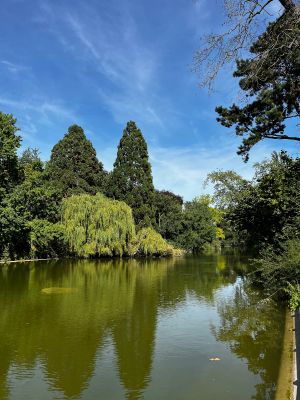
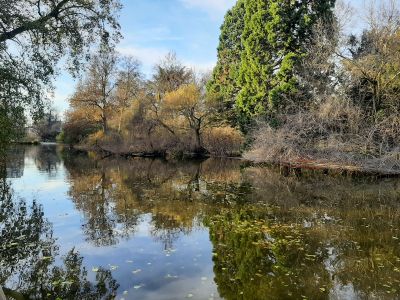
Lac de Saint-Mandé is a 1.5-hectare lake in the north-western part of the Bois de Vincennes, on the edge of Saint-Mandé, in Paris's 12th arrondissement. Its oval basin, about 670 metres around and 0.7 to 1 metre deep, holds a single wooded island of roughly 0.7 hectare that visitors cannot reach. An English-style garden surrounds the water, and the chaussée de l'Étang runs along its bank.
A pond existed here since the 13th century, formed by damming the ru de la Pissotte, a stream from the Montreuil hills. Filled in during the 18th century for sanitary reasons, it was reopened in 1860 under Adolphe Alphand, who disinfected it with iron sulfate and lime and connected it to the Bois de Vincennes water network, completed in 1866.
The name of the lake comes from the nearby town of Saint-Mandé, which even placed the water in its coat of arms. Three wavy silver lines on that shield represent the lake, showing how closely the local identity is tied to this spot.
The lake is freely accessible all year round, and a short path circles the entire edge in just a few minutes on foot. The closest metro stop is Saint-Mandé on line 1, and several bus routes also stop nearby.
In 1966, a species of nanoplankton never described before was found in the lake, a rare scientific find in the middle of a city. The small island at the center is off-limits to visitors and serves as an undisturbed refuge for ducks, swans, and other water birds.
The community of curious travelers
AroundUs brings together thousands of curated places, local tips, and hidden gems, enriched daily by 92,917 contributors worldwide.