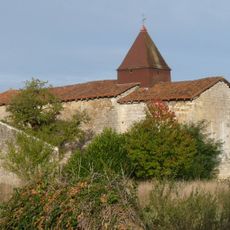
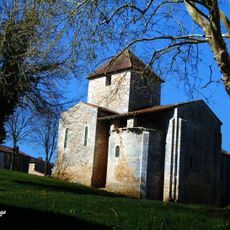
Église Saint-Nicolas, Romanesque abbey in Cellefrouin, France.
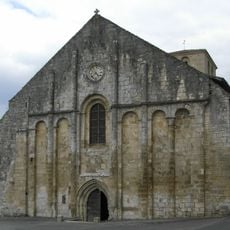
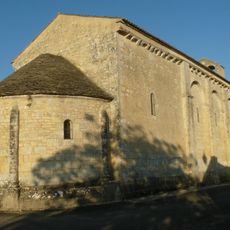
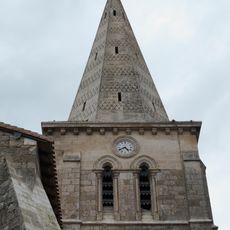
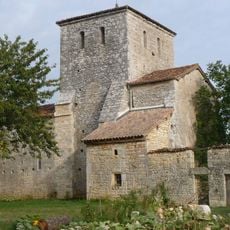
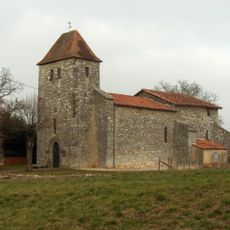
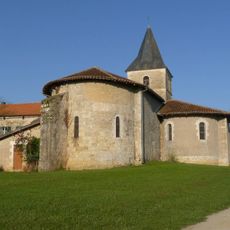
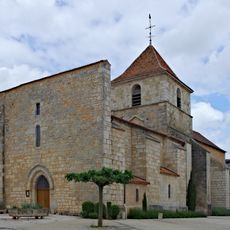
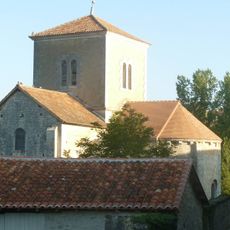
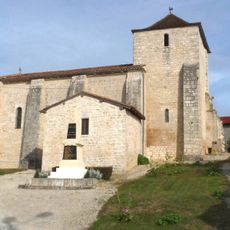
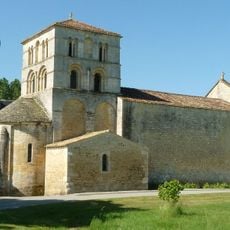
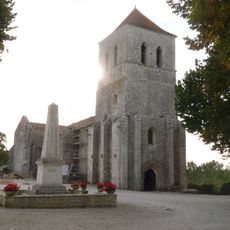
Église Saint-Nicolas, the former abbey church of Saint-Pierre in Cellefrouin, has a west facade with five tall blind arches (the left one destroyed by a later buttress) and a late Gothic portal. The nave is three-aisled with massive piers and a barrel vault; the crossing is topped by a 16th-century square tower with an octagonal lantern base. The chevet has three apses, the central one with a small Agnus Dei relief above its window.
The abbey was founded in the first half of the 11th century when Arnaud de Vitabre, Bishop of Périgueux, established it on land donated by local lord Frouin. This project was part of a broader wave of church building in the Angoumois region during that era.
The name Cellefrouin is linked to Frouin, the most generous of the local donors who helped Arnauld de Vitabre found the monastery around 1025. The church was originally dedicated to the Apostle Peter; since its use as a parish church, probably from the 16th or 17th century, it has been dedicated to Saint Nicholas of Myra. A small square stone carved with an Agnus Dei relief was later set above the central choir window.
The former abbey church, now the parish church of Cellefrouin, is entered through the pointed-arched doorway beneath the west window; steps lead down into the three-aisled interior. Look for the Agnus Dei relief set above the central choir window and the two small round openings lighting the crossing. The monastic buildings are gone, so the church is what remains to visit.
The octagonal dome above the crossing is one of the earliest vaulted structures of its kind in the region, showcasing advanced building techniques from the 11th century. This feature makes the abbey a marker of how medieval architecture was evolving rapidly during that period.
The community of curious travelers
AroundUs brings together thousands of curated places, local tips, and hidden gems, enriched daily by 94,365 contributors worldwide.