Mémorial de la Shoah, Holocaust museum and memorial in the Marais, Paris, France
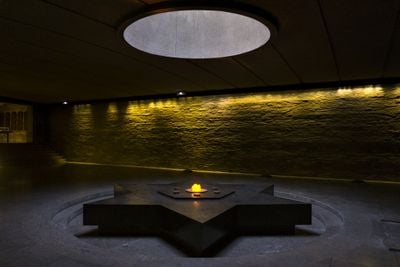
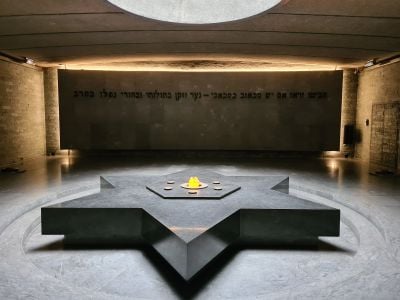
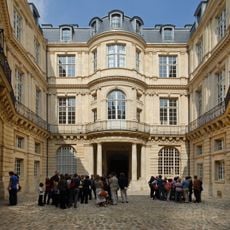
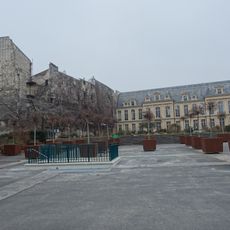
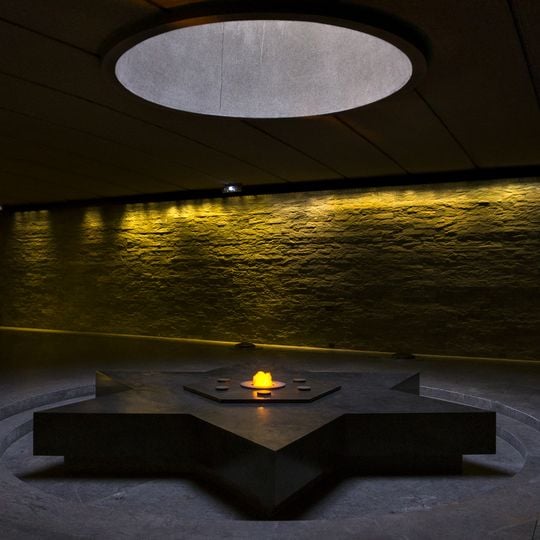
The Mémorial de la Shoah occupies a building at 17 rue Geoffroy-l'Asnier in the Marais, with a forecourt above a crypt. The crypt holds the Tomb of the Unknown Jewish Martyr, a black marble monument shaped as a six-pointed star with an eternal flame at its center. The forecourt includes a bronze cylinder listing the death camps and a wall of seven bas-reliefs by Arbit Blatas.
The Centre de documentation juive contemporaine was founded clandestinely in Grenoble in April 1943 by Isaac Schneersohn and Léon Poliakov to gather evidence of the destruction of European Jews. The Memorial of the Unknown Jewish Martyr, built from 1953 to 1956 by architects Alexandre Persitz and Georges Goldberg, was inaugurated in 1957. In January 2005 the whole site, including the Wall of Names, took the name Mémorial de la Shoah and was opened by President Jacques Chirac on 27 January, the 60th anniversary of the liberation of Auschwitz. A branch opened at Drancy in 2012.
The Wall of Names, cut from stone quarried in Jerusalem, lists 75,568 Jews deported from France between 1942 and 1944, alphabetically by year; visitors leave candles, flowers or pebbles at its foot. Along the Allée des Justes, the Wall of the Righteous, inaugurated on 14 June 2006, names the French Righteous Among the Nations by year of recognition.
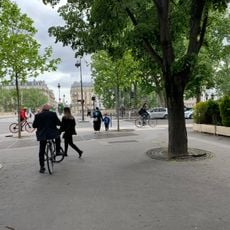
The memorial stands at 17 rue Geoffroy-l'Asnier, with a second entrance at 5 rue du Grenier-sur-l'Eau in the Marais. The documentation centre on the upper floors holds 40 million archive documents, 90,000 photographs and 80,000 books and periodicals, open to researchers and to anyone tracing family records. The forecourt, crypt and Wall of Names are reached from the paved courtyard; the Wall of the Righteous runs along the Allée des Justes beside the building.
The crypt beneath the forecourt holds the Tomb of the Unknown Jewish Martyr, a black marble monument shaped as a Star of David with an eternal flame at its centre, built by architects Alexandre Persitz and Georges Goldberg. On 24 February 1957 ashes of Jews murdered in the death camps and in the ruins of the Warsaw Ghetto, mixed with soil from Israel, were placed inside. A door from the Beaune-la-Rolande internment camp faces the tomb.
The community of curious travelers
AroundUs brings together thousands of curated places, local tips, and hidden gems, enriched daily by 92,912 contributors worldwide.