Cap de la Chèvre, Maritime headland in Crozon Peninsula, France.
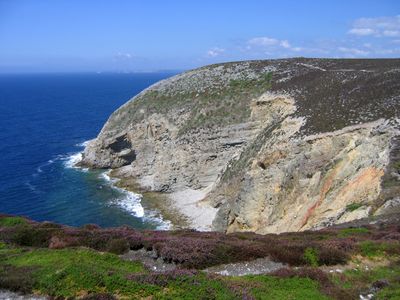
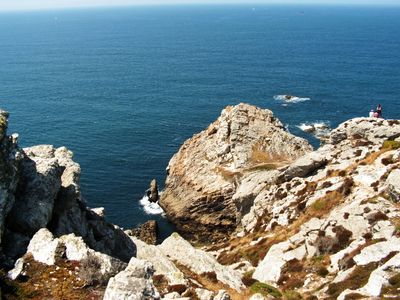
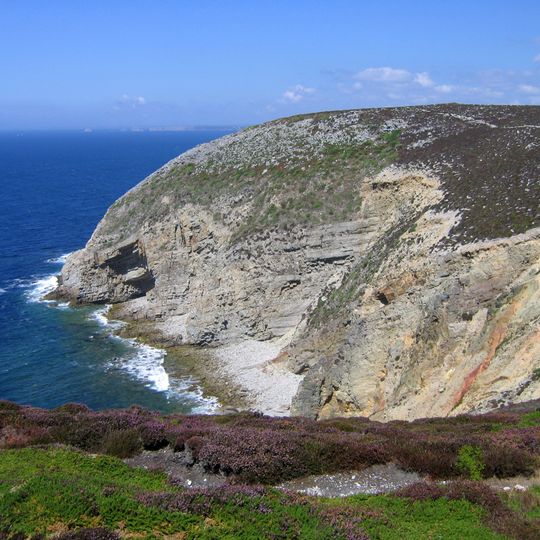
Cap de la Chèvre is the southern cape of the Crozon Peninsula in Finistère, rising over 100 metres above the sea. Its eastern cliffs expose pale grey-beige quartzite beds of the Armorican sandstone formation, while the western side shows reddish conglomerates and siltites of the Cap de la Chèvre Formation. The top is covered with low heath of grey heather and Le Gall's gorse, and a small pebble cove lies at the foot of the cliff.
The cape's rock is Armorican quartzite and red conglomerate of the Crozon Peninsula, folded during the Hercynian orogeny and later cut back by differential marine erosion. During World War II the German Kriegsmarine installed an artillery battery of four 15 cm guns here; its remains are still visible.
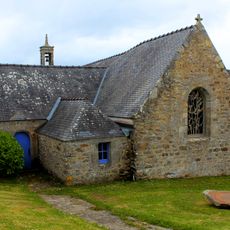
The cape's Breton name, Beg Penn ar Roz, means "head of the hill of the rose," while the French name means "goat cape." The surrounding hamlets keep low houses of local sandstone with slate roofs, several of them converted from older thatched cottages. Since the 1990s the heath has been restored and grazed by sheep from the Conservatoire du littoral.
The GR34 hiking trail is the main way to reach the cape, connecting several viewpoints overlooking Sein and Ouessant Islands. Plan for uneven terrain and watch the tides, as they affect access to certain areas.
The cape's Breton name, Beg Penn ar Roz, refers to the headland itself rather than a goat. On the eastern cliffs, the lower member of the Armorican sandstone formation appears as massive banks of pale grey-beige quartzite, while the western side begins with reddish conglomerates of the Cap de la Chèvre Formation, about 25 m thick and locally tilted upright.
The community of curious travelers
AroundUs brings together thousands of curated places, local tips, and hidden gems, enriched daily by 94,049 contributors worldwide.