Viaduc des Rochers Noirs, Suspension bridge in Lapleau and Soursac, France
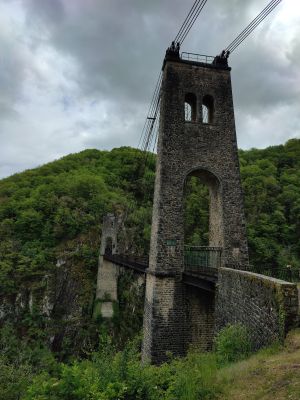
The Viaduc des Rochers Noirs is a suspension bridge whose metal deck hangs from a Gisclard-system cable structure between two stone masonry towers, one taller with a pyramid-shaped cap and arched openings. It spans the Luzège gorge at its narrowest point between Lapleau and Soursac. A sign on the right tower reads "VIADUC DES ROCHERS NOIRS" and "MONUMENT HISTORIQUE".
Built between 1911 and 1913, the bridge was constructed as part of a steam railway line connecting Tulle and Ussel. After the railway service ended in 1959, the structure fell into disuse before being restored in recent years for pedestrian and cyclist traffic.
The name comes from the dark rocks visible in the gorge below, which remain a striking feature of the landscape today. The site has become embedded in local hiking culture, with walkers and cyclists now discovering the old rail route as part of a wider network of paths.
Several hiking trails surround the site, with one route passing beneath it via a footbridge for closer views of the gorge. Visitors can walk, cycle, or mountain bike across the main structure itself, which offers expansive views while crossing.
The bridge uses the Gisclard system, patented by Albert Gisclard and built by Ferdinand Arnodin's firm. It was the second bridge in France to adopt this technology, after the Cassagne bridge in the Pyrénées-Orientales, and its cable layout prefigured modern cable-stayed bridges. Look for the crossing cable layers that meet at mid-span.
The community of curious travelers
AroundUs brings together thousands of curated places, local tips, and hidden gems, enriched daily by 95,352 contributors worldwide.