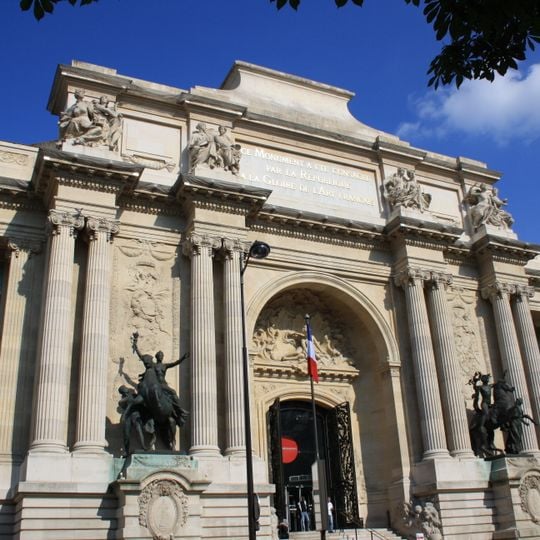
Palais de la Découverte, Science museum in Grand Palais, France
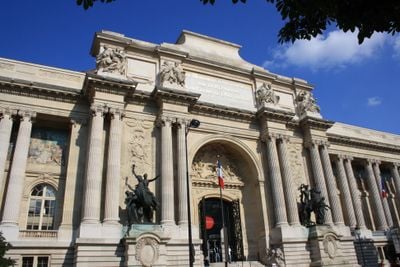
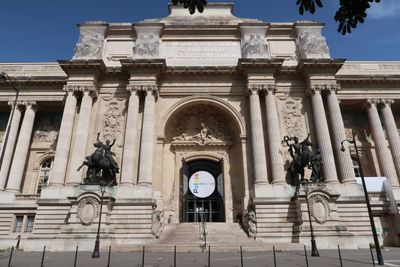
The Palais de la Découverte occupies 25,000 square metres in the west wing of the Grand Palais, the Palais d'Antin built for the 1900 Exposition Universelle to designs by Albert-Félix-Théophile Thomas. Its stone facade carries a rounded archway flanked by fluted columns, with a panel inscribed "CE MONUMENT A ETE CONSACRE PAR LA REPUBLIQUE A LA GLOIRE DE L'ART FRANCAIS" and two bronze equestrian statues before it. Inside, a circular room displays 707 digits of pi as large wooden characters on the dome-like ceiling. The museum has been closed since 2020.
The museum opened in 1937 during the International Exhibition of Arts and Technology and was initiated by Nobel laureate Jean Perrin to make scientific education accessible to a wide audience. The institution remained permanently open after the exhibition and was later integrated into the structures of the French Ministry of Higher Education.
The museum's name comes from its founding aim: showing "science in the making" rather than finished results. Jean Perrin wanted the public to watch experiments performed live, and demonstrations of liquid air and electrostatics have barely changed since 1937 because of their success. The pi room, a circular space with 707 digits of π fixed as large wooden characters to the dome-like ceiling, keeps an 1873 error by William Shanks that went unnoticed until 1946.
The Palais de la Découverte has been closed since 2020 for renovation, with reopening announced for 2027. During the works, science activities and a planetarium for school groups continue at Les Étincelles, six wooden marquees covering 770 m² in the Jardin Caroline-Aigle, an extension of the Parc André-Citroën in the 15th arrondissement. The nearest metro access to the closed Grand Palais site is Champs-Élysées-Clemenceau.
The physics section houses a walk-in Faraday cage where visitors can witness high-voltage demonstrations up close while the metal structure fully protects them from electrical discharges. This demonstration shows in a clear way how electromagnetic shielding works in everyday situations.
The community of curious travelers
AroundUs brings together thousands of curated places, local tips, and hidden gems, enriched daily by 93,435 contributors worldwide.