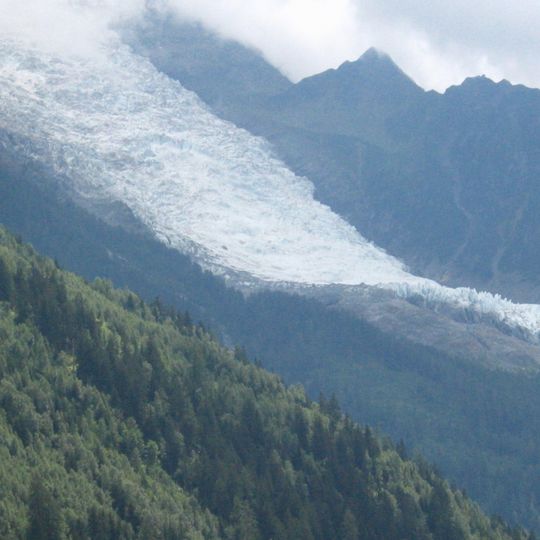
Glacier des Bossons, Alpine glacier in Chamonix-Mont-Blanc, France
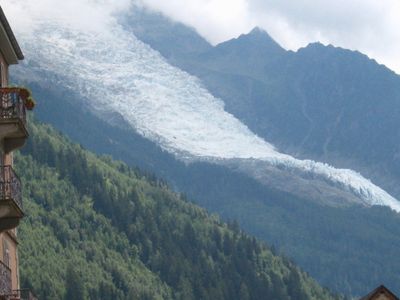
Bossons Glacier is an ice mass in Chamonix-Mont-Blanc that descends from the Mont Blanc summit through a series of ice cascades and broken sections. The structure displays multiple distinct terraces of ice that create a stepped appearance down the mountainside.
In the 17th century the glacier reached the settlement of Le Fouly above Chamonix, burying farmland, barns and houses, and local bishops were called on to exorcise it. William Coxe saw ice walls about a hundred feet high in 1777, gone by his return in 1785. Retreat began around 1784; after a surge around 1815 the community set up a cross before the snout, a marker used for a century. In 1820 an avalanche on the Mont Blanc expedition of Dr Joseph Hamel swept three guides into a crevasse; two bodies emerged at the glacier's terminus in 1861.
The name may derive from a Celtic root meaning "that which stands below", fitting a glacier at the foot of Mont Blanc; another hypothesis links Bosson to the old French Boisson, bush, as Horace-Bénédict de Saussure wrote "glacier des Buissons" in 1787. In 1815, after a renewed surge, the frightened inhabitants of Chamonix erected a cross before the snout, used as a retreat marker for a century.
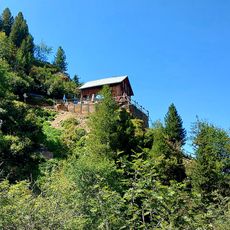
A chairlift from 1960 brings visitors to a vantage point where the ice can be observed from above. The ground is uneven and rocky, so sturdy footwear is recommended for walking in the area.
In August 1820 an avalanche on the glacier swept away three Chamonix guides from Dr Joseph Hamel's expedition. Two of the bodies were recovered at the glacier's terminus in August 1861, and the surviving guide Joseph-Marie Couttet, then 72, identified the remains.
The community of curious travelers
AroundUs brings together thousands of curated places, local tips, and hidden gems, enriched daily by 93,549 contributors worldwide.