Château de Quéribus, Castle ruin in Cucugnan village, France.
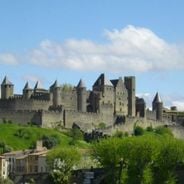
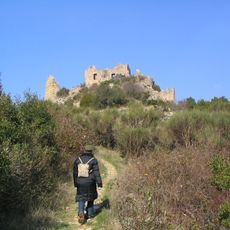
Château de Quéribus stands on a narrow rocky ridge at 728 metres above Cucugnan, its weathered grey and tan stone following the crest. At one end rises a thick cylindrical tower with small rectangular openings; lower walls link it to a rectangular section, then a longer wall steps down to a smaller square tower and further ruined masonry. Three tiered enclosures hold a keep with a ribbed vault on a single central pillar, cisterns and storage rooms.
Quéribus is first mentioned in 1021 in the testament of Bernard I Tailefer, Count of Besalú, and stood in the viscountcy of Peyrapertusès. Chabert de Barbaira held it for the Cathars and surrendered it in May 1255 to Olivier de Termes, a former comrade. The treaty of Corbeil (1258) made it a royal frontier fortress, one of the "Five Sons of Carcassonne"; it was besieged and taken by Aragonese troops in 1473, lost its strategic role with the treaty of the Pyrenees in 1659, and was restored from 1951.
The name Quéribus comes from the Occitan for "rock of boxwood". After Montségur fell in 1244, Cathar bishop Benoît de Termes had already resided here in 1230, and the castle became one of the last refuges of the Cathar Church. The Occitan name Castèl de Querbús is still used locally.
The climb to the castle is steep and requires sturdy shoes and reasonable fitness, especially on warm days. Bring plenty of water, as shade is limited at the hilltop.
The keep's top floor is covered by a ribbed vault of four cross-ribs resting on a single central pillar, a detail easy to miss among the ruins. From the keep, the view takes in the Pyrenees, the Mediterranean and the Corbières vineyards. The castle was listed as a monument historique in 1907.
The community of curious travelers
AroundUs brings together thousands of curated places, local tips, and hidden gems, enriched daily by 94,351 contributors worldwide.