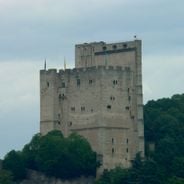
Château de Tarascon, Medieval castle in Tarascon, France
Château de Tarascon stands on a rocky island in the Rhône, its 45-metre walls rising directly from the water. The seigneurial lodge has two round towers on the east and two square towers on the west, linked by curtain walls of the same height. A projecting parapet with corbels and small cylindrical turrets tops the walls, and a lower wing bears a red and white banner reading "les marchands".
Louis II of Anjou ordered the castle rebuilt on its old site on 27 November 1400; work resumed from 1428 to 1435 under his son Louis III. Architect Jean Robert directed the works, with sculptors Simon de Beaujeu and Jacques Morel, using stone from Beaucaire quarries. King René made small changes from 1447 to 1449 and replaced the drawbridge with a fixed bridge between 1476 and 1479.
The castle is also the Centre d'art René d'Anjou, named after the king who stayed here often and had his bust and that of Queen Jeanne de Laval placed in a niche of the inner courtyard. The lower court now holds the apothecary of the Saint-Nicolas hospital, with more than two hundred faience jars from Saint-Jean-du-Désert and Montpellier set in 18th-century woodwork.
The castle is open daily with varying admission costs based on age. The riverside location allows visitors to approach on foot along the waterfront, giving views of its full scale before entering.
The castle served as a prison from the 18th century until 1926, holding enemy sailors among others. The damage caused by this use was repaired by architects Henri Antoine Révoil and Jean Camille Formigé, and it was during their restorations that the crenellated parapet was reinstated.
The community of curious travelers
AroundUs brings together thousands of curated places, local tips, and hidden gems, enriched daily by 93,438 contributors worldwide.