Viaur Viaduct, Railroad bridge in Tauriac-de-Naucelle, France
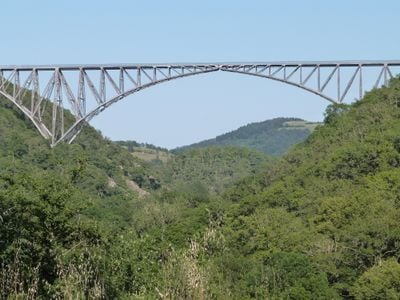
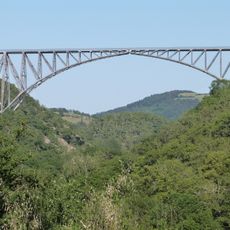
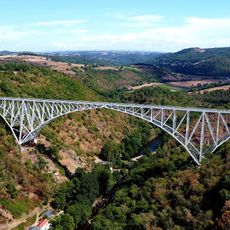
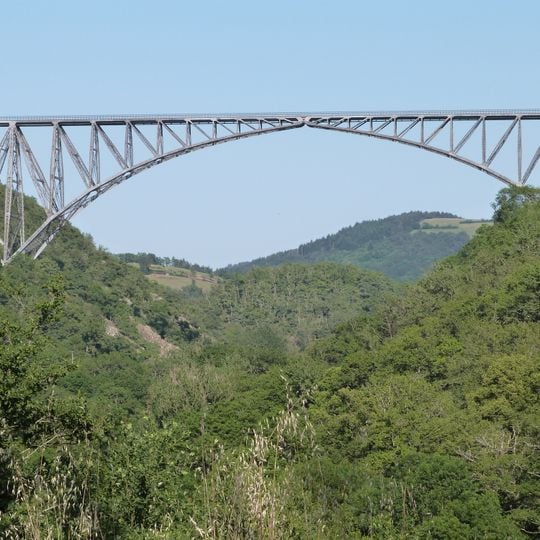
The Viaur Viaduct is a single-track steel railway bridge on the Carmaux–Rodez line, crossing the Viaur valley between Tauriac-de-Naucelle and Tanus. Its 460 m length includes a 220 m main arch formed by two balanced cantilever beams, with the track running along the top of the structure. The steelwork, assembled with rivets, weighs 3,800 tonnes and stands 116 m above the river.
A competition opened in 1887, with Gustave Eiffel among the entrants, was awarded to Paul Bodin of the Société de construction des Batignolles, who built the viaduct between 1895 and 1902 with engineer Rosario de Volontat. Jean Compagnon, former site chief for the Garabit and Maria Pia viaducts and the Eiffel Tower, died in 1900 before completion; his successor Gaboris finished the work. The two halves met on 4 July 1902 and the bridge was inaugurated on 5 October 1902, with no fatalities during construction.
Painter Henri-Marcel Magne depicted the riveters at work on a flying scaffold in his canvas Construction d'un Viaduc. The Occitan writer Joan Bodon made the viaduct and its effect on Ségala's wheat farming the subject of his tale Lo Pan de Froment (The Wheat Bread).
Visitors can explore the bridge from several viewpoints along the Viaur Valley, including Aire du Gô and Aire Paul Bodin, which offer different perspectives. It is advisable to visit both locations to see the structure from various angles.
The central span of 220 meters uses two balanced frameworks that meet in the middle, allowing the structure to adjust to loads, temperature changes, and wind. This construction method was innovative and enabled the bridge to be flexible and stable at once.
The community of curious travelers
AroundUs brings together thousands of curated places, local tips, and hidden gems, enriched daily by 93,509 contributors worldwide.