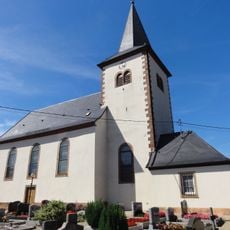
Neubourg Abbey, Cistercian abbey in Dauendorf, France.
Neubourg Abbey is a ruined Cistercian monastery in Dauendorf, of which only a Baroque portal from 1744, a mill and parts of the enclosing wall remain. The portal has a rounded arch framed by reddish-brown masonry, a triangular pediment with carved ornament and finials, and square pillars with carved bases and capitals. A carved wooden panel, now in the Musée historique de Haguenau, shows an oval shield with a three-towered castle and two seated figures, flanked by winged child figures.
The monastery was established in 1133 when Count Renaud de Lutzelbourg sent twelve monks and an abbot from Lucelle Abbey to create a new religious community. The site grew to become an important Cistercian center before declining in later centuries.
The abbey's name comes from its first abbot, Ulrich, count of Neubourg and Burgundy, a cousin of Saint Bernard; the monastery was called Neo castrum after him. The wooden rococo fittings from the abbey church, including choir stalls, organ case, pulpit and statues, are now in Saint-Nicolas in Haguenau, and the Bienenbrunnen fountain stands before Saint-Georges there.
The ruins stand in the Moder valley on the edge of Neubourg, a hamlet of Dauendorf, about nine kilometres west of Haguenau. What remains is the 1744 baroque portal, a mill and stretches of the enclosure wall, listed as a monument historique since 1990. The grounds are uneven and partly overgrown, so sturdy shoes help; the carved wooden panel is not on site.
The abbey's 18th-century 24-face sundial was moved to Mont Sainte-Odile in 1935. The Bee Fountain now stands by Saint-Georges in Haguenau, and the altar is in Rottelsheim's church. The carved wooden panel in the photographs, with its oval shield and two reclining winged children, is among the rococo fittings kept in Saint-Nicolas in Haguenau.
The community of curious travelers
AroundUs brings together thousands of curated places, local tips, and hidden gems, enriched daily by 93,633 contributors worldwide.