Château de Grosbois, Renaissance castle in Boissy-Saint-Léger, France
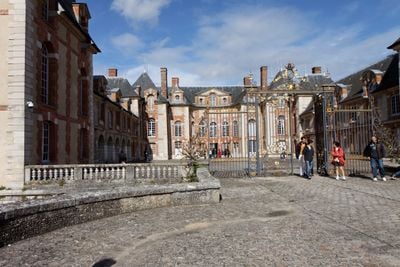
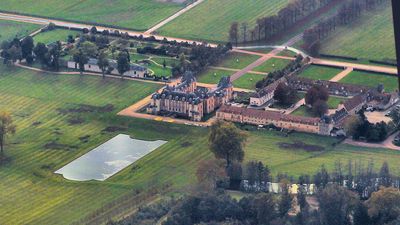
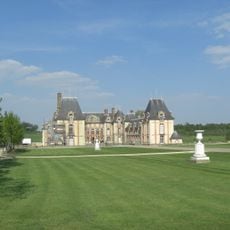
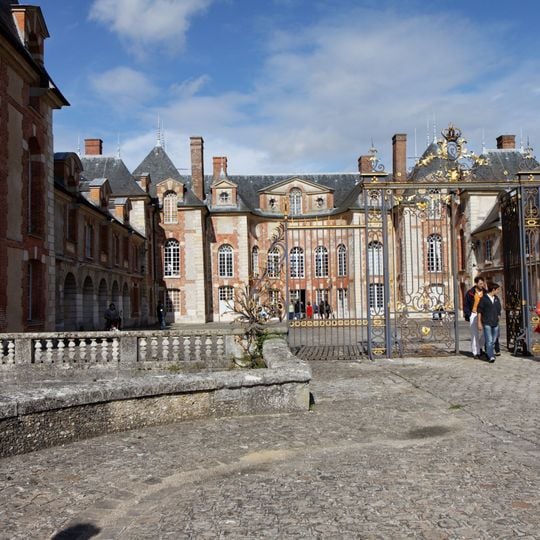
Château de Grosbois is a U-shaped Renaissance château in Boissy-Saint-Léger, built on a rectangular platform surrounded by a dry moat and reached by three bridges. Its central wing curves into an exedra, flanked by two pavilions of equal height and two lower wings at right angles. The red-brick facade has light stone quoins, a triangular pediment, and round-arched windows with fanlights; an ornate gilded iron gate opens across the courtyard entrance.
Raoul Moreau, treasurer of the Épargne, bought the Grosbois lands from the abbey of Saint-Victor in 1563. In 1597 Nicolas de Harlay had Florent Fournier build the central block, left unfinished in 1616 when Charles de Valois bought it; he completed it around 1640, adding the enclosing wall (1623) and the two wings. Confiscated in the Revolution, it was sold in 1797 to Barras, then in 1801 to General Moreau, and granted by Napoleon to Marshal Berthier in 1805.
Inside the château, the Battle Gallery displays large paintings and busts that show how French military leaders wanted to be remembered. Today visitors walk slowly through this room to look at faces and uniforms from another time, often pausing before the scenes of Napoleonic battles.
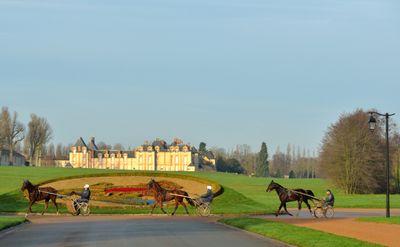
Wear comfortable shoes because the park and gardens cover open ground that takes time to cross on foot. The estate is near Paris and easy to reach for a day visit, but much of the space is used for horse training, so keep to marked paths.
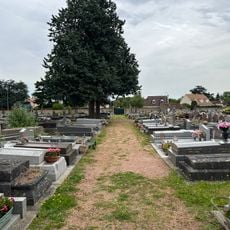
In 1962 the estate was bought by René Ballière, president of the Société d'encouragement à l'élevage du cheval français, who turned it into a training centre for racehorses. The château stands in Boissy-Saint-Léger, not Marolles-en-Brie, the neighbouring commune named on the sign beside the gate. The last Prince of Wagram, wounded in 1914, died in 1918 and is buried here with the 2nd and 3rd princes.
The community of curious travelers
AroundUs brings together thousands of curated places, local tips, and hidden gems, enriched daily by 93,489 contributors worldwide.