Chateau de la Hunaudaye, Medieval castle in Plédéliac, France.
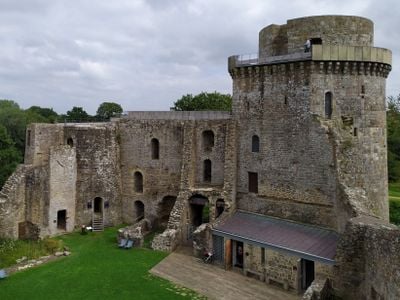
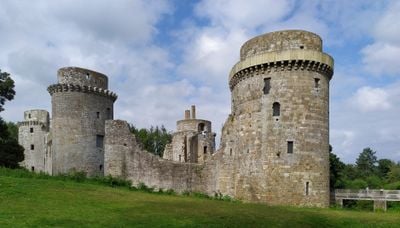
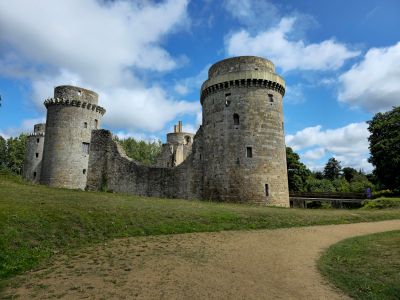
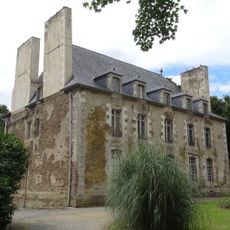
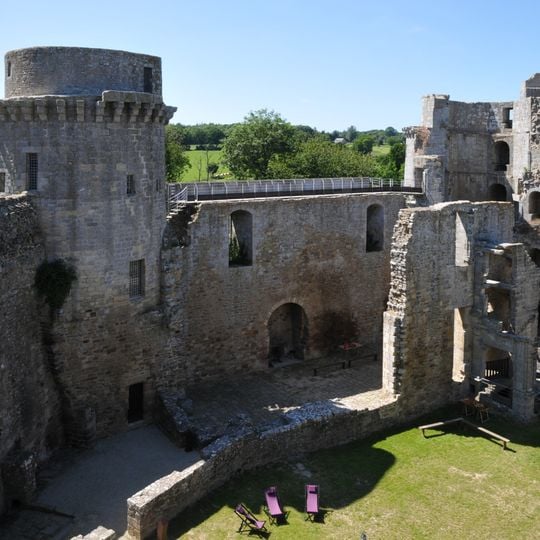
The Château de la Hunaudaye is a ruined granite castle on an island in a wide moat in Plédéliac, reached by a drawbridge. Its irregular pentagonal plan is marked by five round towers joined by curtain walls; the west and south-east towers date from the 13th century, the other three from around 1400. Against the west wall stands the ruined logis, with an 18-metre hall, a Renaissance staircase and a vaulted cellar.
Olivier Tournemine built the first castle here in 1220 with the duke's permission, to guard the eastern border of Penthièvre against Dinan. English troops and Jean de Montfort's forces destroyed it in 1341 during the Breton War of Succession. Pierre Tournemine began rebuilding at the end of the 14th or start of the 15th century, adding three towers to two surviving ones. The site was sacked in the Revolution and set on fire in 1793.
The name comes from the Tournemine family, lords of La Hunaudaye, who held the castle for three centuries and took the side of the Penthièvre during the Breton War of Succession. In the south-east tower, reliefs with religious motifs were long read as traces of a castle chapel; they are now attributed to monks held prisoner there, who carved them during their captivity.
The ruin stands on an island in a broad moat, reached by a drawbridge that still serves as the entrance. It is open to visitors for a fee from early April to early November. The grounds are grassy and uneven, with low ruined walls and exposed ledges, so sturdy shoes help.
The southeast tower was long thought to be a castle chapel because of religious reliefs carved inside. It is now considered a prison, where captive monks likely made those carvings. The castle stands on a marshy hollow occupied since the 4th century by a Gallo-Roman military camp.
The community of curious travelers
AroundUs brings together thousands of curated places, local tips, and hidden gems, enriched daily by 94,019 contributors worldwide.