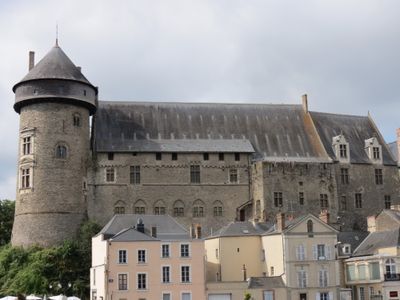
Château de Laval, Medieval castle in Laval, France.
Château de Laval comprises two distinct parts: the Old Castle with medieval fortifications and the New Castle featuring Renaissance architectural elements. Both sections can be explored together to see how the building evolved across different periods.
Guy I founded the castle in the first half of the 11th century, and the town of Laval grew only afterwards. His earthwork castle, with a motte and bailey, covered about a third of today's historic centre. The House of Laval held it until the end of the Renaissance, adding a 12th-century chapel, a 13th-century wooden hoarding on the main tower, and a Renaissance gallery in the 1540s.
The Old Castle houses the Museum of Naive and Singular Arts, which has displayed works from these artistic movements since 1967. This collection transforms the medieval walls into a space where contemporary artistic expressions find their home.
The castle can be explored through either guided or self-guided visits, with both options taking you through the different sections. It helps to allow enough time to properly see both the medieval and Renaissance areas plus the museum collections.
The Old Castle's main tower is crowned by a 13th-century wooden hoarding, a rare surviving example of medieval military architecture. The castle's triangular enclosure, about 100 metres on each side, was laid out by Guy I in the first half of the 11th century; the site was chosen at the tip of a rocky spur rather than its highest point because the slopes gave natural protection.
The community of curious travelers
AroundUs brings together thousands of curated places, local tips, and hidden gems, enriched daily by 93,930 contributors worldwide.