Murol Castle, Medieval fortress in Puy-de-Dôme, France
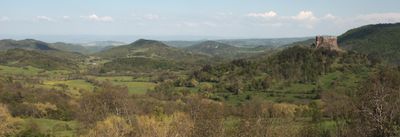
Murol Castle stands on a basalt outcrop at about 1,000 metres above the village of Murol. Its inner enceinte is polygonal and follows the rock's contours, with a 13th-century keep, the Tour de Chautignat, and two chapels below a large circular tower. A long curtain wall with almond-shaped towers runs down the slope, and the ruined Renaissance palace and a small wooden shelter with a reddish-brown roof stand against the walls.
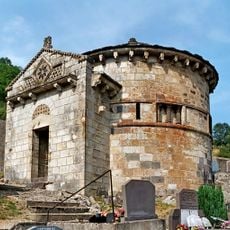
The castle was built on a basalt outcrop from the 11th century, with a Romanesque chapel and defensive walls from the 11th–12th centuries. Guillaume II de Murol strengthened it in the 14th century, adding a funerary chapel. In 1455 Jehanne de Murol married Gaspard d'Estaing, and their descendant François I d'Estaing added a bastioned curtain wall and an unfinished Renaissance palace in the 16th century.
The castle's name comes from the Murol family, whose last heir Jehanne married Gaspard d'Estaing in 1455. Today costumed guides and son et lumière shows present daily life in a medieval castle, and medieval martial arts displays are held in the lower courtyard.
The site is accessible on foot via a regular path leading to the top of the basalt rock. Good footwear is helpful because the surfaces are uneven and can be slippery when wet.
Guy de Maupassant described the ruins in his short story "Humble drame" (1883), and George Sand used them in her novel "Jean de la Roche" (1859). The Musée des peintres de l'École de Murol keeps Jean Fernand-Trochain's painting of the castle in winter.
The community of curious travelers
AroundUs brings together thousands of curated places, local tips, and hidden gems, enriched daily by 94,657 contributors worldwide.