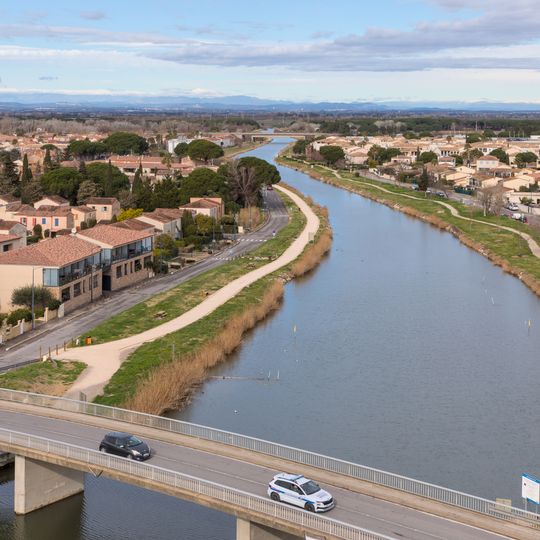
Canal du Rhône à Sète, Commercial waterway in southern France.
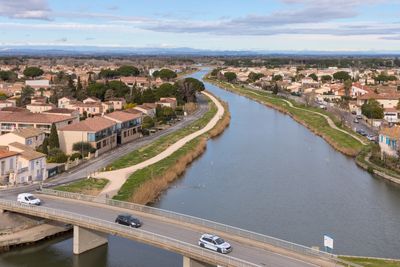
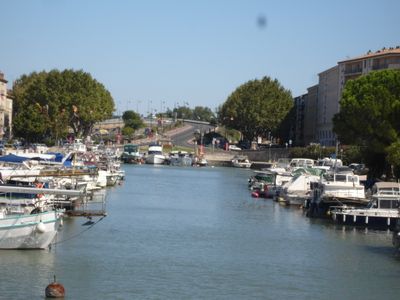
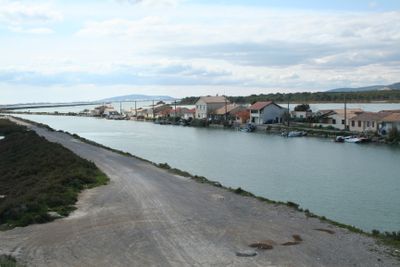
The Canal du Rhône à Sète is a 98-kilometer shipping channel linking the Rhône at Beaucaire to the Étang de Thau at Sète. It runs through flat terrain: wide, low earth banks with reeds and grass, a gravel path on one side, and stone embankments with moored boats in built-up sections. It has only one lock along its entire length.
The États de Languedoc decided in 1773 to build a canal from Beaucaire to Aigues-Mortes on a plan by Isaac Étienne Grangent, to free Rhône–Sète trade from the Petit-Rhône. Work stopped in 1789 and resumed after the law of 16 March 1801; the first boats passed in 1806, and the canal was definitively accepted on 29 September 1828, costing 16 million francs instead of 2.5 million. Engineer Paulin Talabot replaced salt water with fresh water up to Aigues-Mortes, finishing a guard lock there in 1834.
The waterway passes through towns like Aigues-Mortes and Saint-Gilles where traditional fishing boats and working harbors shape daily life along the banks. Locals still use the canal for small-scale fishing and recreational boating, keeping maritime traditions visible to travelers.
The canal has only one lock along its entire length, so passage is straightforward for houseboats. Access to the Rhône at Beaucaire is closed since the Vallabrègues dam was built; boats reach the river instead through the lock west of Saint-Gilles, which connects to the Petit Rhône. A bypass section now skirts Aigues-Mortes and its railway swing bridge.
The canal has only one lock along its entire length, which makes it easy to navigate and popular for houseboat holidays. From the banks, visitors can spot wild horses, wild bulls, flamingos and many bird species in the surrounding wetlands.
The community of curious travelers
AroundUs brings together thousands of curated places, local tips, and hidden gems, enriched daily by 94,657 contributors worldwide.