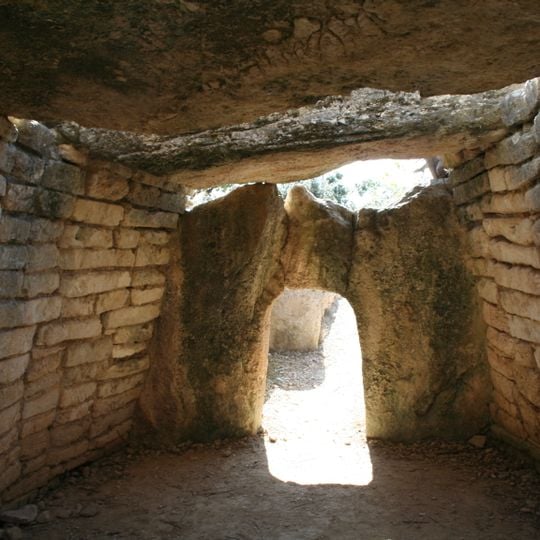
Gallardet Dolmen, Ancient burial site in Le Pouget, France.
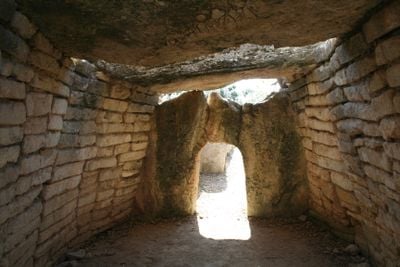
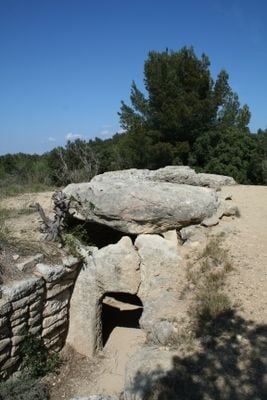
Gallardet Dolmen is a passage grave near Le Pouget, built of local limestone. A monumental door slab, 4.25 m wide and 2.12 m high, is pierced by a trapezoidal opening 1.25 m high and 0.6–0.9 m wide, with a second arc-shaped hole at its top. Behind it, the chamber measures 5.75 m by 3.25 m and is roofed by three capstones, the largest 3.2 m long and 0.75 m thick.
Excavated in 1956 after earlier looting, the dolmen was fully restored between 1981 and 1984. Its dry-stone walls had collapsed, likely because the slabs were laid like stacks of plates without blocking stones. The covering slabs fell in succession, except the first, partly held by the door slab.
Four wall stones were recognised as reused stelae: one triangular example from the antechamber wall was polished on its faces, with one side rounded and the other flattened. The dolmen is also known as the dolmen du Pouget, after the commune where it stands.
The dolmen stands on a hill above the left bank of the Hérault plain, reached on foot. The corridor opens to the south-southeast and is only about 2.6 m long today, so the entry is low and narrow. The chamber is open to the sky where capstones are missing, and the floor is dry earth.
The interior reveals a remarkable detail: flat stones are arranged like overlapping plates to support the massive ceiling stones. This simple yet ingenious stacking method gives the structure surprising stability and longevity.
The community of curious travelers
AroundUs brings together thousands of curated places, local tips, and hidden gems, enriched daily by 94,458 contributors worldwide.